This is a November 24, 2026 report of a civil case still at the complaint stage. It separates who measured each dollar figure, and when, from what a court had actually awarded.
On Monday, November 23, 2026, the U.S. Department of Justice filed a civil forfeiture complaint in the U.S. District Court for the District of Columbia. The filing seeks to seize more than $1.1 billion in USDC linked to the October hack of Binance. As described via crypto.news, the complaint targets USDC across 36 addresses on 18 blockchains. A civil forfeiture complaint asks a court to award specified property to the government. Filing it does not, by itself, transfer title.
The complaint says the attackers gained unauthorized access to Binance’s network on or around October 29 and transferred roughly $6 billion in cryptocurrency to addresses they controlled. Cointelegraph had also reported a theft of roughly $6 billion. Elliptic’s estimate is higher, at $6.43 billion. Those are different published totals, not one live mark of every coin still outstanding.
What was already blocked before November 23
Circle, which issues USDC, had already blocked access to the funds. On November 6 it told the government it would keep the USDC blocked if prosecutors sought a temporary restraining order. A 14-day restraint was granted that day. The November 23 filing asks the court to keep the restrictions in place for the duration of the case. Prosecutors said they were unaware of any other claimants. That is the government’s statement in the case, not a finding that no other party will come forward.
The USDC block sits inside a wider set of freezes, and the headline amounts are not interchangeable:
- The Justice Department said that by November 12, work with private companies had frozen more than $2.7 billion in stolen assets, and that courts had authorized the government to seize or restrain more than $1.2 billion inside that total.
- Tether said on November 2 that it had frozen more than $1.5 billion in USDT within 30 minutes of the attack.
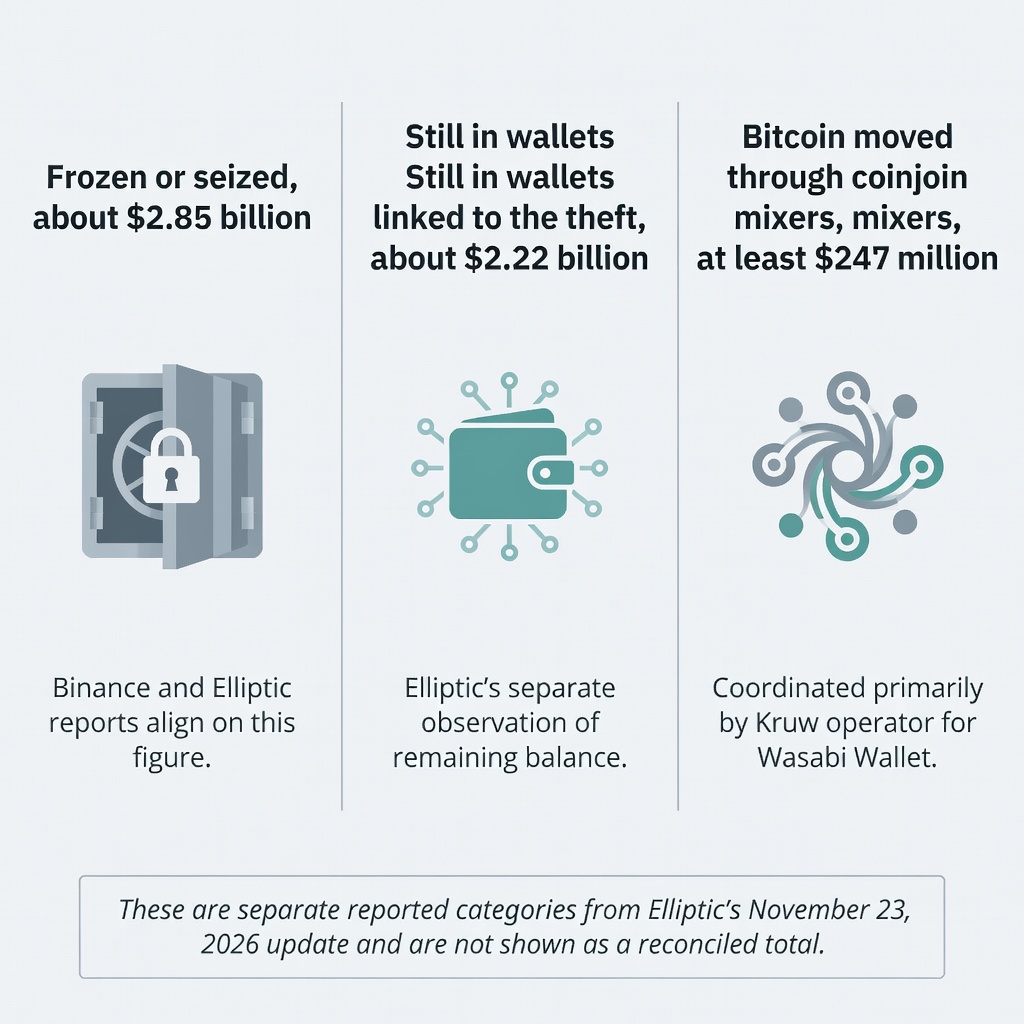
- Binance puts assets frozen or intercepted at about $2.85 billion.
- Elliptic’s update on November 23 also reported $2.85 billion frozen or seized.
The Justice Department, Tether, Binance, Circle, and Elliptic are describing overlapping efforts, not one audited ledger. USDC itself was not being revalued. In the market snapshot printed with the November 24 report, CoinPaprika data as of 21:40 UTC on November 23, 2026 showed USDC at $1.00 (₹92.96), essentially flat over both the prior day and the prior week. A Circle block stops the affected units from moving. It does not change the printed peg. The forfeiture request is about control of dollar-denominated tokens already quoted at par.
What Elliptic says was still outside the freeze
Elliptic reported that the hackers had moved at least $247 million in Bitcoin through coinjoin mixers, which combine coins and make individual units harder to follow. Co-founder Tom Robinson told Decrypt that almost all of that coinjoin activity was coordinated by one person: the operator of Kruw, described as the most widely used coinjoin coordinator for Wasabi Wallet users, who “refuses to block funds such as these.” Mixing accelerated after November 17.
The same Elliptic update said about $2.22 billion remained in wallets linked to the theft. The report lists that wallet balance, the mixer flow of at least $247 million, and the $2.85 billion frozen or seized as separate observations. It does not add them up or reconcile them with either the roughly $6 billion figure or Elliptic’s own $6.43 billion estimate. A frozen amount, a balance still in linked wallets, and a smaller sum already sent through mixers are different statements about location. They are not a single valuation of the hack.
On November 17, Elliptic said, the attacker emptied five of the nine largest Ethereum addresses tied to the theft, moving about 488,000 ETH. The firm marked that quantity at roughly $860 million at the time. The dollar figure is a conversion on that date, not a standing value. Elliptic said the coins were being swapped into Bitcoin through the Thorchain bridge and then sent into coinjoins, often within hours. Decrypt described the sequence as the same approach used after the $1.5 billion Bybit hack in early 2025.
Elliptic said the operation had spanned more than 27,000 wallets across at least 16 blockchains, roughly 55 services, and some 90,000 transactions. That chain count is Elliptic’s wallet-graph measure. It is not the same figure as the 18 blockchains named for the USDC addresses in the forfeiture complaint. The firm said the movement was clearly automated, but that it found no evidence AI agents were directing it. It pointed instead to conventional software with fixed timing, set amounts, and pauses that, in Elliptic’s reading, resemble human working patterns in Pyongyang.
One quantity was stated only as a coin amount. The 18,270 BTC stolen directly from Binance had not moved since the attack. The November 24 report does not give that holding a dollar value.
Attribution, and what Binance says it paid
The FBI, U.S. Secret Service, and IRS Criminal Investigation attributed the theft to North Korean military hacking groups known as Lazarus Group and APT38. An FBI alert specifically named the actors as TraderTraitor. That is an agency attribution, not a verdict described in the complaint. North Korea has denied involvement through a statement by Kim Yo Jong. Binance has said the hackers tricked an employee into downloading malicious software.
On customer losses, the exchange says it covered all of them with its own funds, set aside more than $6.34 billion, and used its own money to buy replacement tokens. Those are Binance’s statements about funding a customer make-whole. They are not a measured accrual to any token holder, and this report does not present them as an audited remainder of the exchange’s equity. Binance has also secured a court order in Abu Dhabi to help recover frozen assets. A hearing in that case was scheduled for December 1, 2026, on whether restrictions on the frozen assets should continue.
U.S. officials have called North Korea’s crypto thefts a significant source of funding for its weapons programs. The November 24 report does not independently measure that link.
What was still unresolved
As of November 24, 2026, the U.S. case was a pending forfeiture action. Whether Circle’s block remains, and whether further seizures follow, were left as the practical tests of how much of the dollar-denominated portion can be recovered. Elliptic’s expectation—not a completed result—was that laundering would continue through mixers and eventually through over-the-counter brokers.
The only market prices attached to the report were a snapshot, not a claimed effect. CoinPaprika data as of 21:40 UTC on November 23, 2026 showed Bitcoin at $61,274 (₹5,695,855), up 0.9% in the prior 24 hours and down 6.2% over the prior week. The report does not tie that weekly move to the hack, the filing, or the mixer flows. For the asset the Justice Department is seeking, the relevant observation is the USDC print at $1.00: the disputed units were already pegged dollars, and the open question was who could move them.