
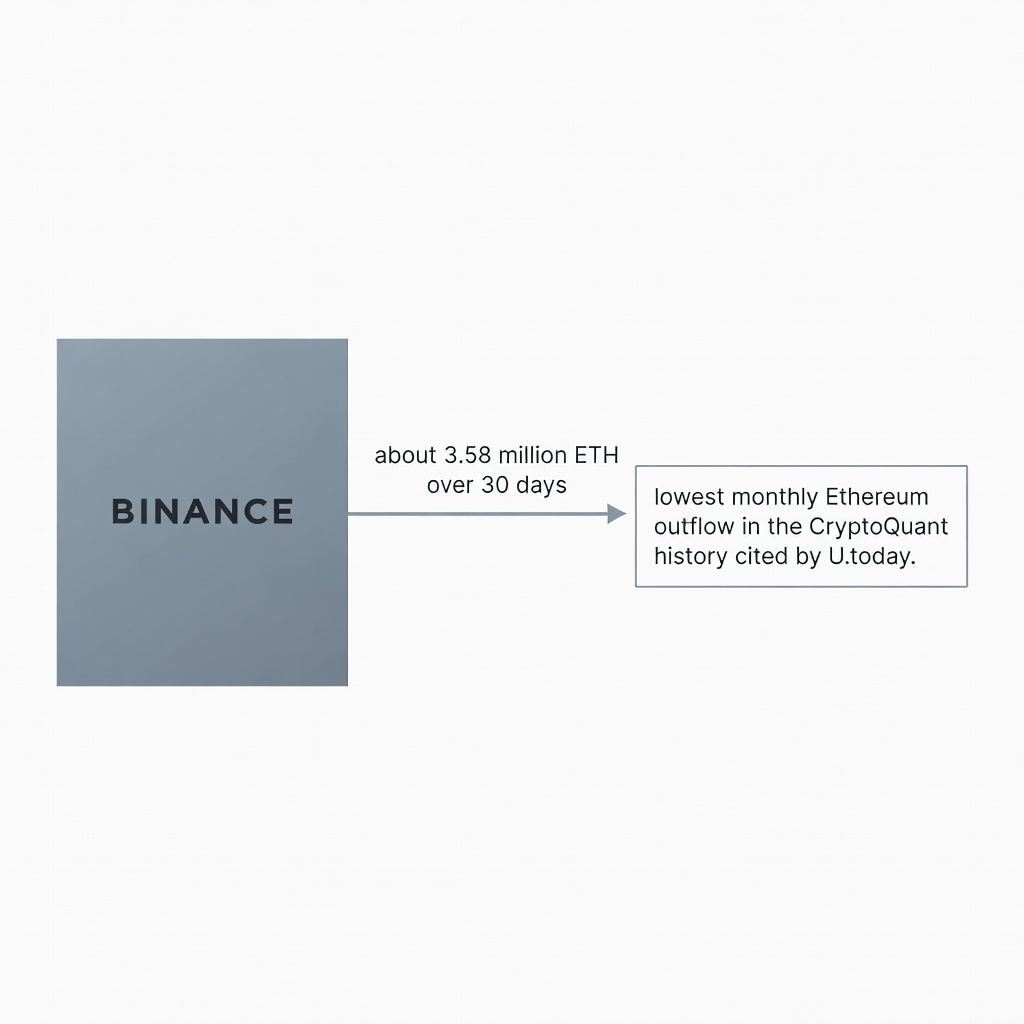
A 24 November 2026 report, drawing on U.today and CryptoQuant exchange-flow metrics, put withdrawals from Binance at about 3.58 million ETH over the preceding 30 days. U.today described that total as the lowest monthly Ethereum outflow recorded on Binance, which the write-up called the world’s largest crypto exchange.
The number is a location-of-supply reading. It counts ETH that left one exchange in that window. It is not protocol activity, not fee or other protocol revenue, and not a measure of value accruing to ETH holders. Traders often use exchange outflows as a rough proxy for coins moving toward self-custody rather than remaining where they can be sold quickly. On that reading, a record low means less ETH was reported leaving Binance than in earlier months in the CryptoQuant history cited by U.today. It does not set a fair value, and it does not show whether ETH was cheap or expensive while it traded near $1,700.
The flow window was a period in which Ethereum was trading around $1,700 and Binance was still dealing with the fallout of a major security breach, the report said. A separate CoinPaprika snapshot, timestamped 23 November 2026 at 18:04 UTC, priced ETH at $1,742 (₹161,922), up 1.6% over 24 hours and down 4.3% over seven days. Market cap was $212.98 billion on 24-hour volume of $9.17 billion. Those figures describe the market at that timestamp. They are not outputs of the outflow series.
Blockchain trackers identified multiple large ETH withdrawals by the Binance hacker, according to the report. Those movements did not produce a rise in overall Ethereum outflows from Binance. Security incidents more often coincide with holders shifting coins into wallets they control. U.today said that, setting the attackers’ withdrawals aside, Binance’s ETH holders did not follow that pattern in any measurable way. The report does not offer a single explanation. It treats the slower outflows as consistent with a wider bearish tone in exchange activity and with weaker investor sentiment, not as a standalone vote of confidence in the exchange’s security.
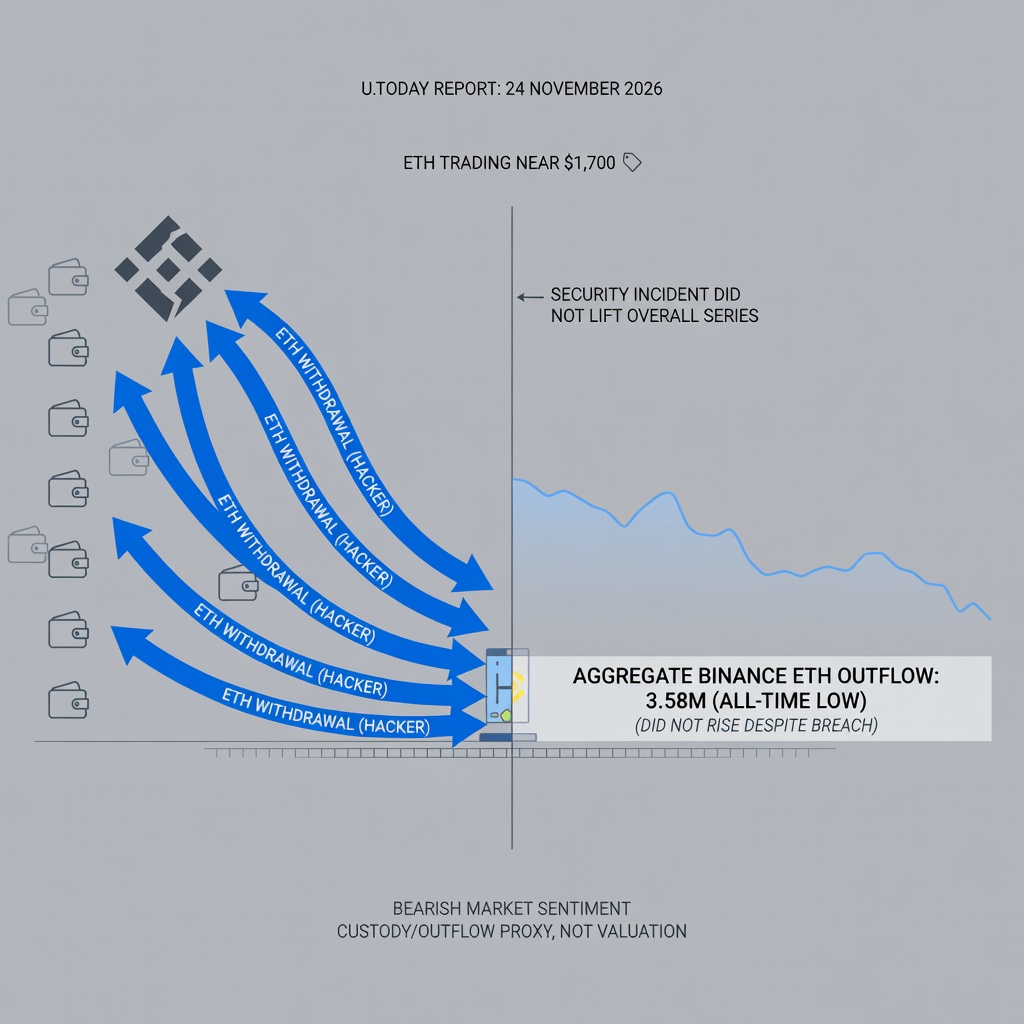
For supply, the distinction is narrower than a bullish or bearish call. Less ETH leaving Binance leaves more of the reported balance on a single venue at a moment when a breach might ordinarily have pushed coins into self-custody. That is a custody and available-supply observation. It is not evidence that holders are receiving protocol cash flows, and the report does not convert it into a valuation multiple. The same write-up places the ETH figure next to another Binance signal from the stretch: BTC funding turning negative as Bitcoin slid 17.4% in November. Those are concurrent descriptions, not a demonstrated link between Bitcoin’s November decline and the ETH outflow low.
The limits sit in the data as presented. The print covers one exchange and one 30-day window, and the “all-time low” label applies only to the CryptoQuant history cited by U.today. Sentiment is the report’s interpretation of why outflows shrank, not a separate measured confidence score. The write-up points to the next monthly CryptoQuant reading as the check on whether 3.58 million ETH was a floor or a pause. A rebound in outflows, or a fresh spike tied to the hacker’s wallets, would be the clearest test of how holders were moving coins. Neither outcome is reported in the 24 November 2026 account.