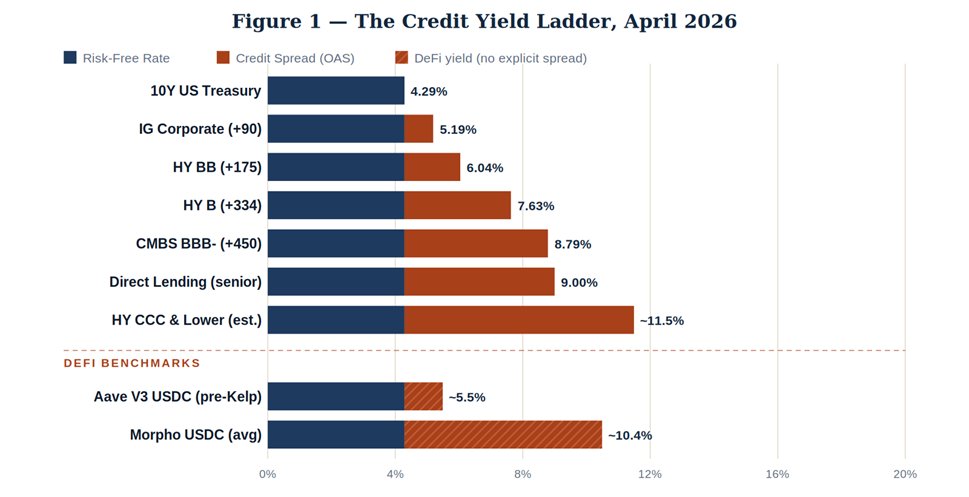
Historical analysis based on an article published April 27, 2026, at 18:03 UTC+8. The incident figures and valuation assumptions below are attributed to the original article, not independently verified estimates.
A stablecoin deposit rate is a return offered to lenders, not a measure of how safe their principal is. In the original article, Tom Dunleavy asks whether the roughly 5.5% yield available on Aave USDC deposits before the reported KelpDAO incident adequately compensated lenders for losses that can originate outside Aave itself. This is a question about lender risk and yield, not protocol revenue or token-holder value.
The reported losses and the route to lenders
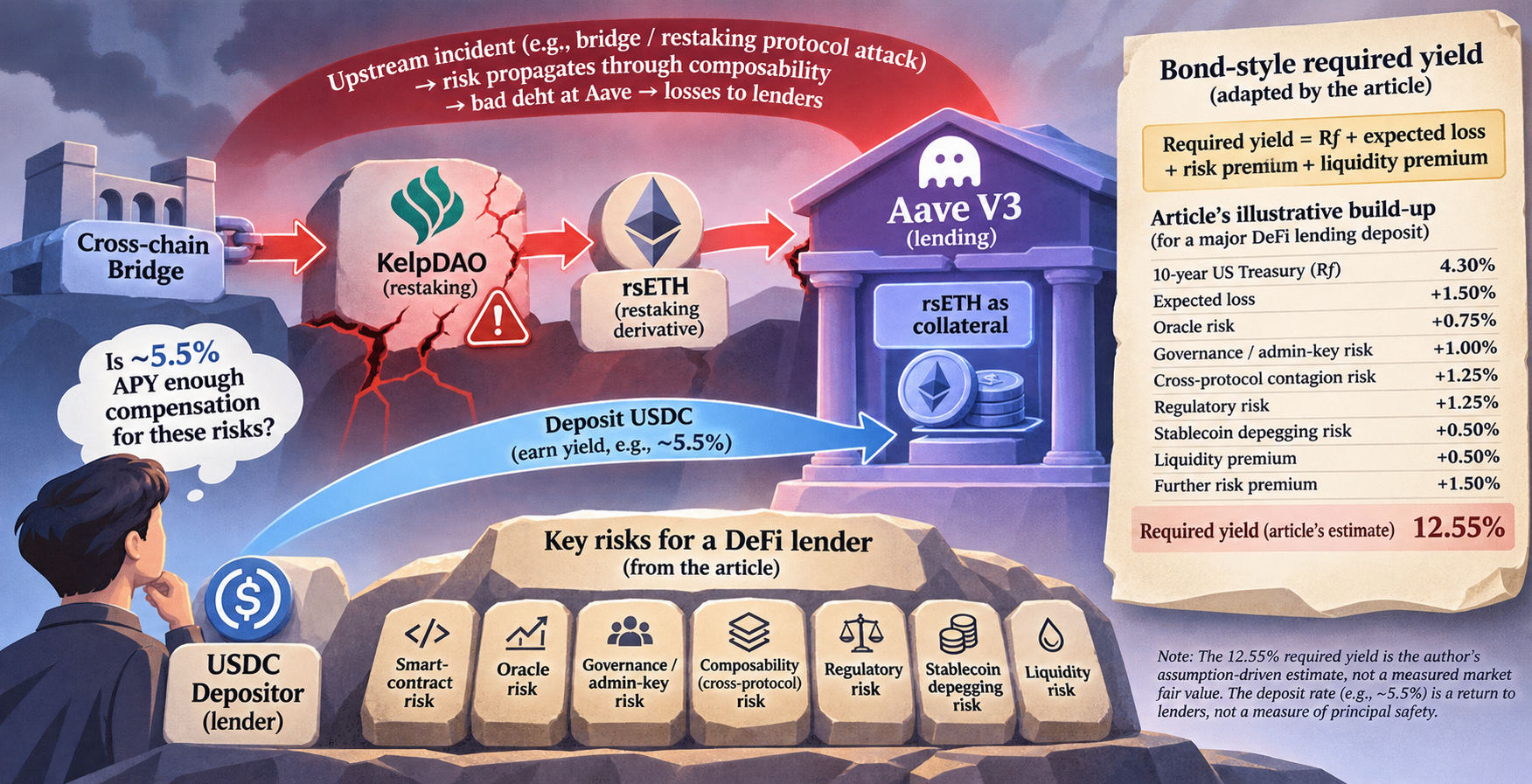
The article reports that Drift Protocol lost $285 million on April 1, 2026, and KelpDAO lost $292 million on April 18. It says stolen rsETH was subsequently deposited into Aave V3 as collateral, leaving Aave with approximately $196 million in bad debt. According to the article, that bad debt arose in about four hours; Aave’s total value locked fell from $26.4 billion to $17.9 billion over three days. It also reports that Aave’s USDC market utilization reached 99.87% for four consecutive days and its deposit rate rose to 12.4%.
The distinction matters for pricing: a lender may face a loss transmitted through collateral and connected protocols even if the lending protocol itself is not the initial target. The article describes this as composability risk alongside smart-contract, oracle, governance and administrator-key risks.
Translating credit pricing into a deposit yield
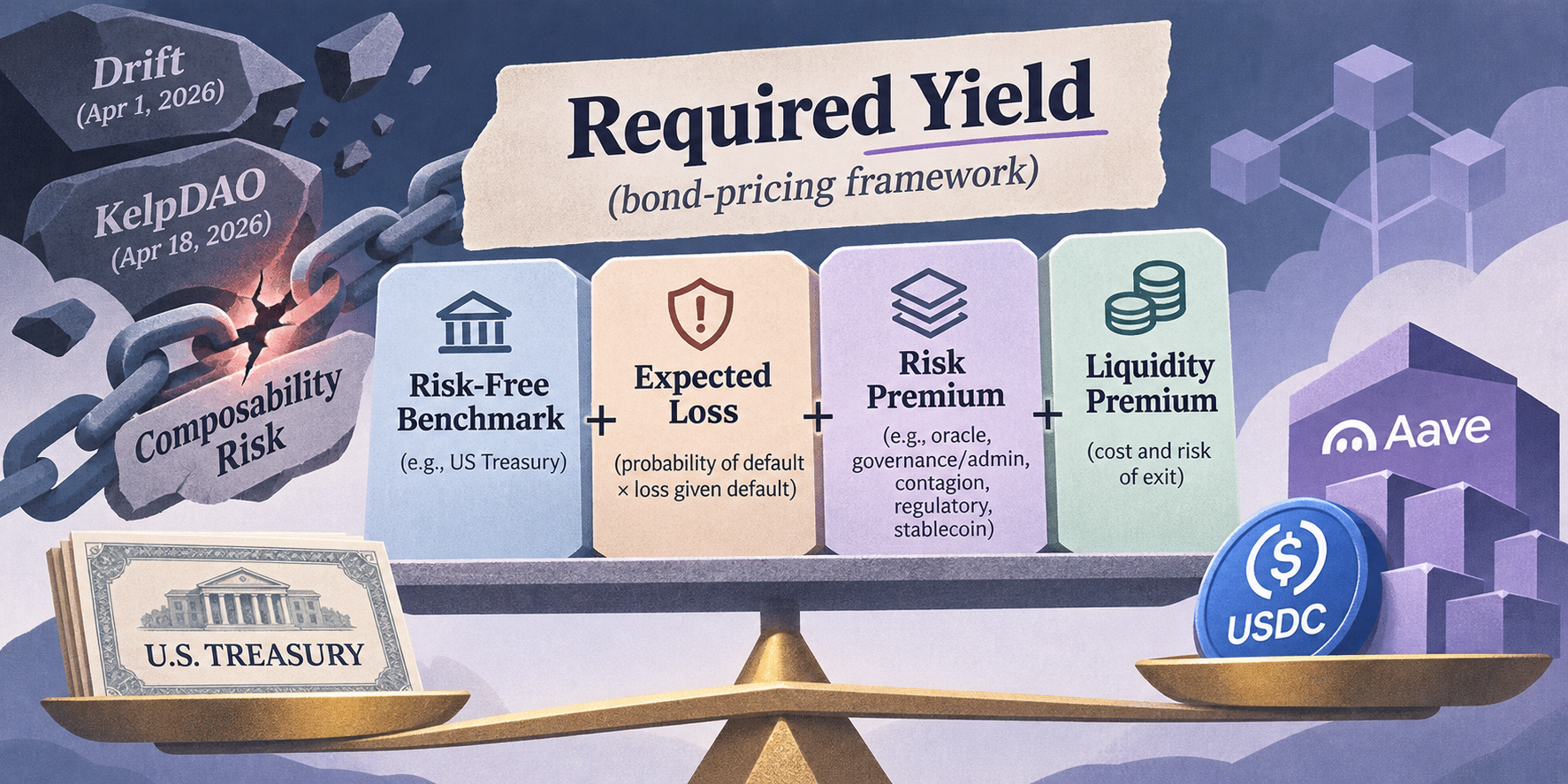
Dunleavy adapts a bond-yield framework:
Required yield = risk-free rate + expected loss + risk premium + liquidity premium.
Expected loss is the assumed probability of default multiplied by the loss given default. For context, the article cites Moody’s long-run data since 1920: a 4.5% annual default rate for US speculative-grade bonds and roughly 40% historical recovery for senior unsecured high-yield bonds. Multiplying the corresponding 60% loss given default by 4.5% produces a 2.7% annual expected loss. Those are bond-market reference figures, not observed DeFi default rates.
For DeFi, the article estimates a forward annual default probability of 1.5%–2.0% for major lending businesses and assumes a 90% loss given default in a severe attack without an external backstop. That yields an estimated 1.35%–1.80% annual expected loss. The assumptions are consequential: the article says its 2026 loss-rate projection of 2.0%–2.5% depends on the pace of incidents continuing, rather than representing a completed-year observation. Its comparison figures are approximately $500 million in DeFi-specific losses against $75 billion average total value locked in 2024, and $600 million against $120 billion in 2025.
What produces the 12.55% estimate?
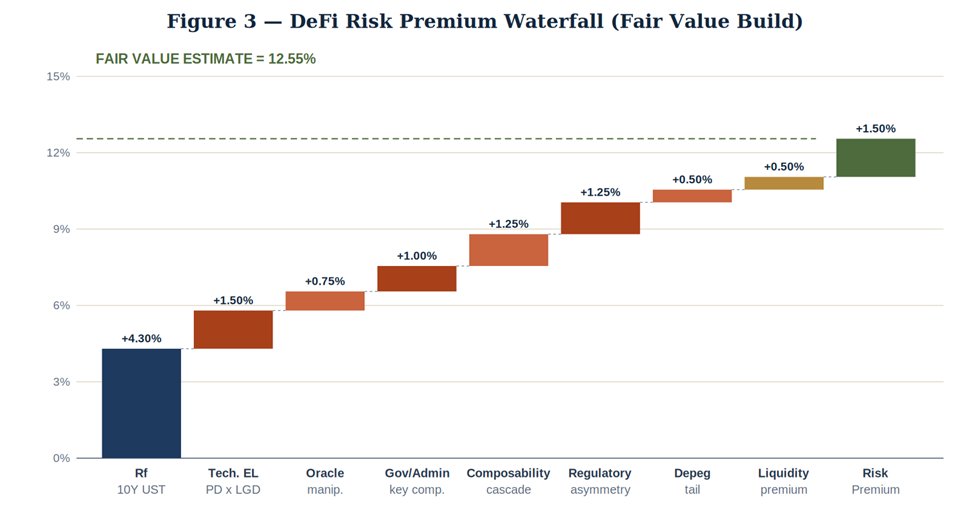
Using a 10-year US Treasury yield of 4.30% as its model baseline, the article adds 1.50 percentage points for expected loss, 0.75 for oracle risk, 1.00 for governance or administrator-key risk, 1.25 for cross-protocol contagion, 1.25 for regulatory risk, 0.50 for stablecoin depegging, 0.50 for liquidity and 1.50 for a further risk premium. The sum is 12.55%. The article separately reports a 10-year Treasury close of 4.29% on the preceding Wednesday; the model uses a rounded 4.30%.
That 12.55% is the author’s assumption-driven required yield, not a measured market fair value. In particular, the article does not establish that every listed premium can be estimated independently or that a 10-year Treasury matches a deposit’s duration. It argues that insurance, reserves and stronger collateral could lower a required premium, while cross-chain exposure or less-established markets could raise it. Those changes would require their own evidence and assumptions.
The useful conclusion is narrower than a universal minimum rate: comparing a DeFi deposit with a bond yield requires specifying the potential loss, recovery, connected-protocol exposures and exit conditions. A quoted deposit APY alone does not supply those inputs.
Source: panewslab.com (originally published 2026-04-27 18:03 UTC+8)