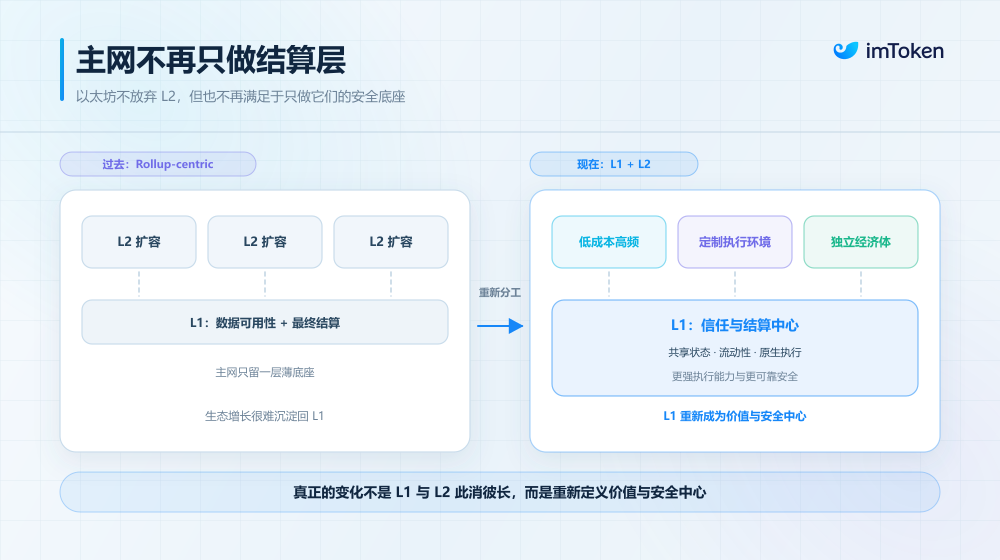
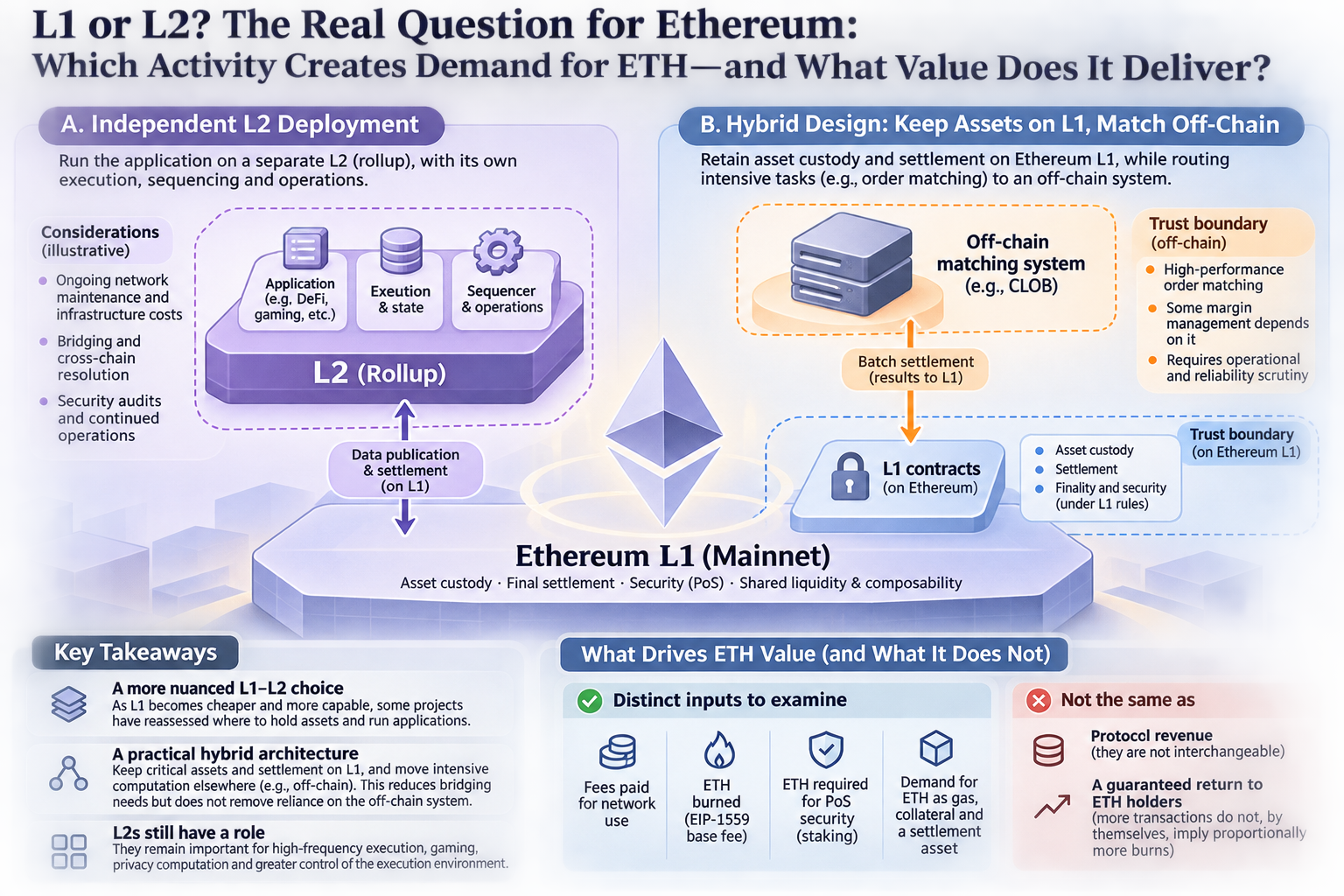
Originally reported by imToken on November 11, 2026, at 21:36 (UTC+8). The article describes a shift in how some projects choose between Ethereum’s mainnet and layer-2 networks (L2s). For ETH valuation, the question is not simply whether more activity moves to L1. It is which activity creates demand for ETH, and whether that demand translates into value for holders.
Why some projects reconsidered L2s
In February 2026, ENS co-founder Nick Johnson said ENS would stop developing its planned Namechain rollup and deploy ENSv2 on Ethereum L1 instead. ENS Labs reported that the average gas cost of registering a name had fallen by about 99% over the preceding year, from nearly $5 to less than $0.05. Against that saving, a dedicated L2 would still require infrastructure, bridging, cross-chain resolution, audits and ongoing operations.
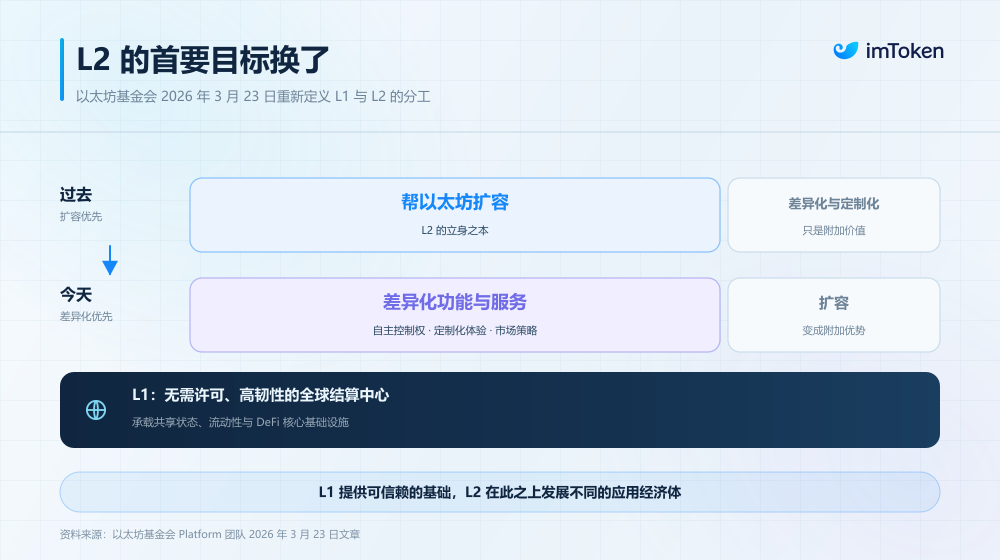
Other projects made different, project-specific decisions. Synthetix launched its next-generation perpetuals exchange on mainnet in December 2025 after arguing that L2 deployment had fragmented liquidity and introduced infrastructure problems. ShapeShift moved its rFOX staking program from Arbitrum to L1 on October 1, 2026, saying most FOX tokens were already held there. The source also reports L1 plans or migrations involving Trueo, Superseed and Nillion. These examples do not establish that L2s generally lack a use case.
The economics of operating a separate network are another consideration. According to the article, Blast said on October 2, 2026, that it would wind down because network maintenance costs exceeded L2 revenue and it saw no reliable path to sustainability. Abstract had announced a planned December 15 shutdown; the article cited more than 144 integrated applications and over 400,000 users, alongside insufficient liquidity, a limited DeFi ecosystem and little institutional participation. Application and user counts alone did not resolve the operating-cost question.
Keeping assets on L1 does not eliminate trade-offs
The article describes a hybrid approach: retain assets and critical settlement on Ethereum while moving intensive computation elsewhere. In Synthetix’s design, L1 contracts custody user assets, an off-chain central limit order book matches orders, and batches of results settle on mainnet. That reduces the need to bridge assets to a separate chain, but it does not remove reliance on the off-chain matching system; the article notes that some margin management depends on it.
L2s still serve applications that need high-frequency execution, gaming, privacy computation or greater control of their execution environment. The source also discusses native-rollup verification and closer cross-rollup interaction as research directions, not deployed solutions. Citing ETHBEAT data as of November 2026, it says only a single-digit number of the L2s tracked had reached Stage 2, while major rollups including Base, Arbitrum One and OP Mainnet remained at Stage 1.
The ETH valuation distinction
Under EIP-1559, a transaction’s base fee is burned and its priority fee goes to validators. More demand for scarce block space can therefore increase ETH burns. But cheaper L2 data publication and greater L1 capacity can reduce the fee paid per transaction. More transactions do not, by themselves, imply proportionally more burns.
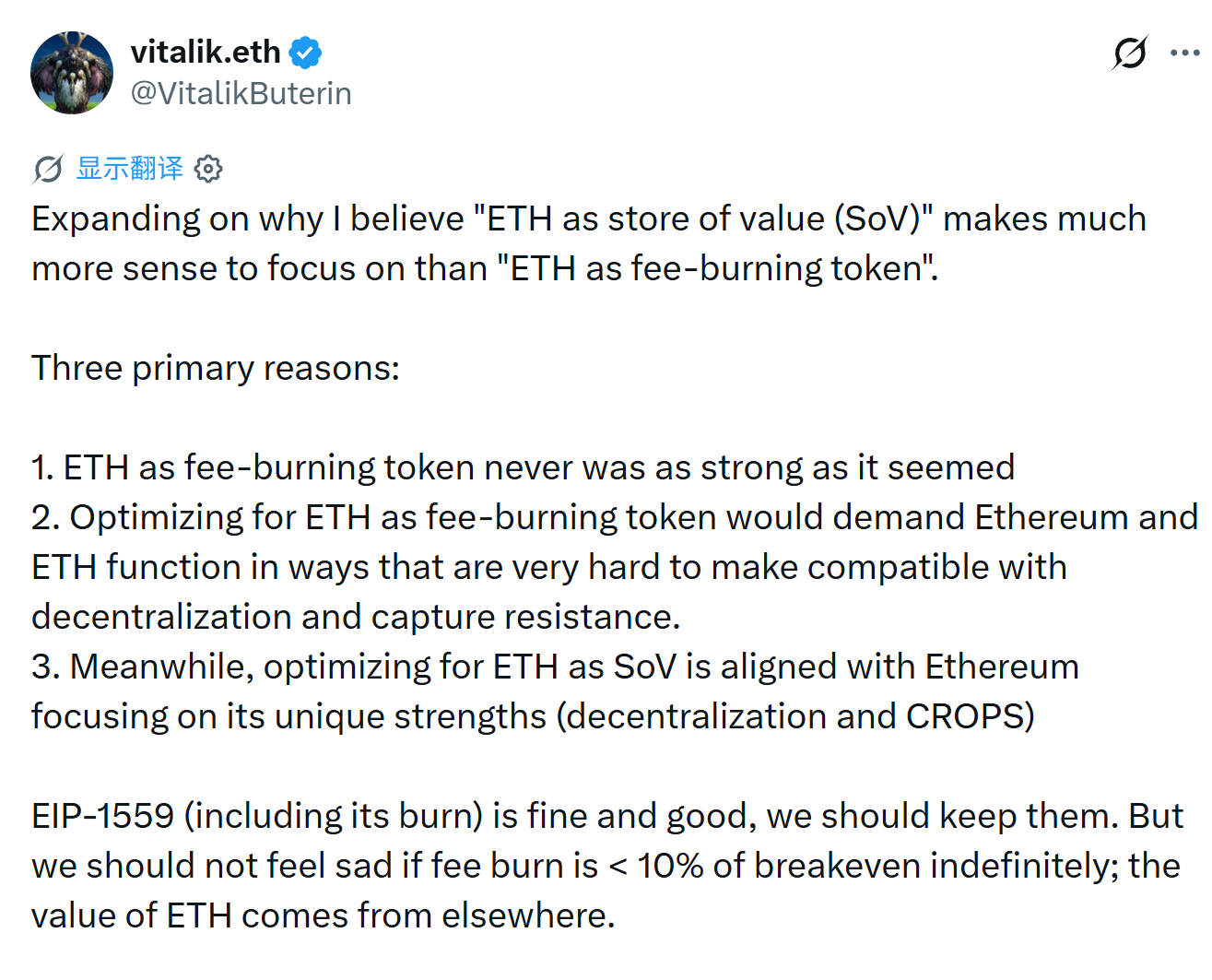
As recounted in the article, Vitalik Buterin argued against making fee burns the principal measure of ETH’s worth. He supported retaining EIP-1559 while emphasizing ETH’s potential role as a store of value and Ethereum’s resistance to censorship and control, open-source character, privacy and security. The article points to the roughly $180 million in fees burned during a single day of the 2022 Otherdeed NFT mint as an example of why an exceptional, speculation-driven fee spike is a weak basis for long-term valuation.
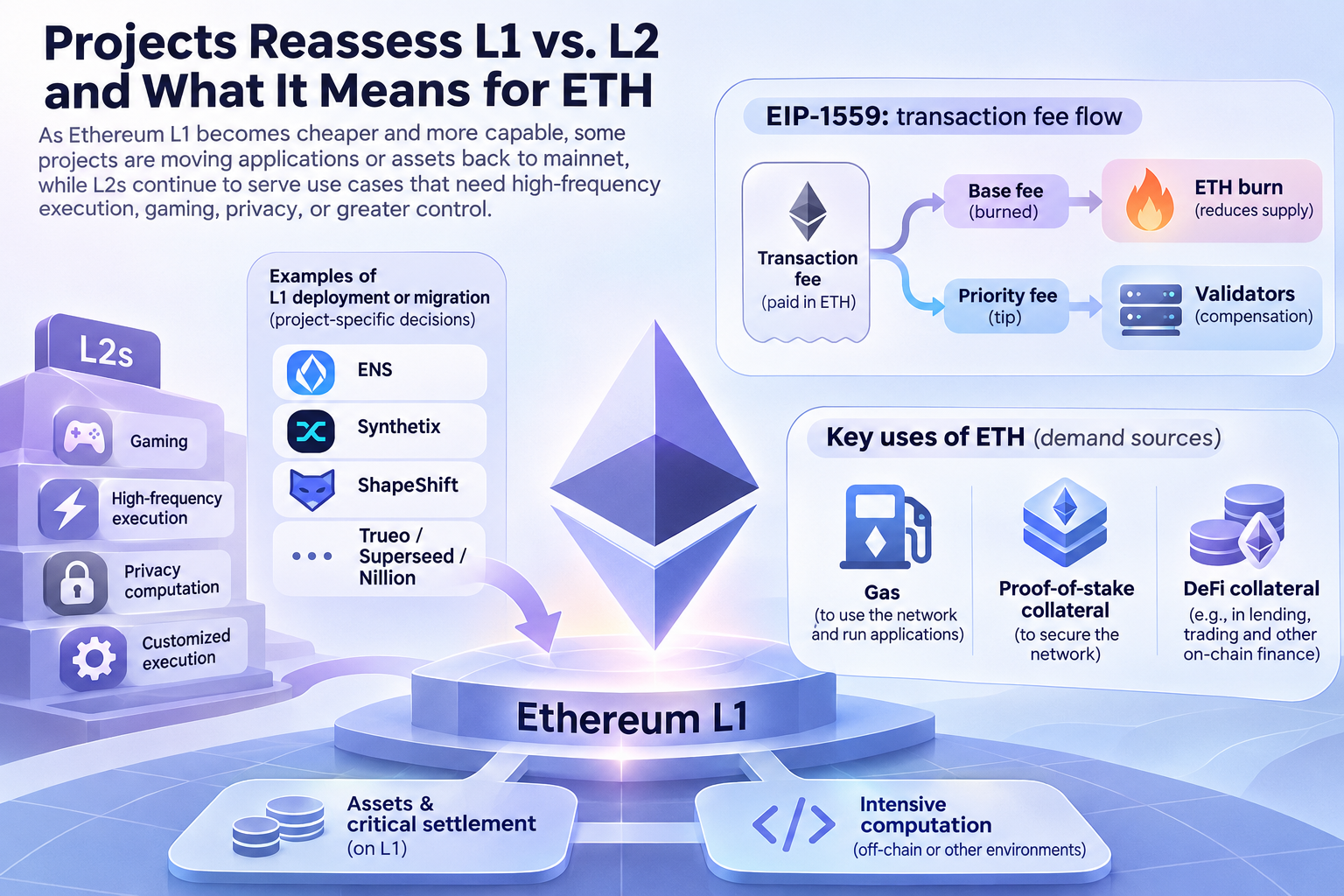
That leaves several distinct inputs to examine: fees paid for network use, ETH burned, ETH required for proof-of-stake security, and demand for ETH as gas, collateral and a settlement asset. None is interchangeable with protocol revenue or a guaranteed return to ETH holders. The cases in this report support a narrower conclusion: as L1 becomes cheaper, projects may reassess where to hold assets and run applications. They do not establish a fair value for ETH or show that every activity returning to mainnet will increase token-holder value.
Source: panewslab.com (originally published 2026-11-11 21:36 UTC+8)