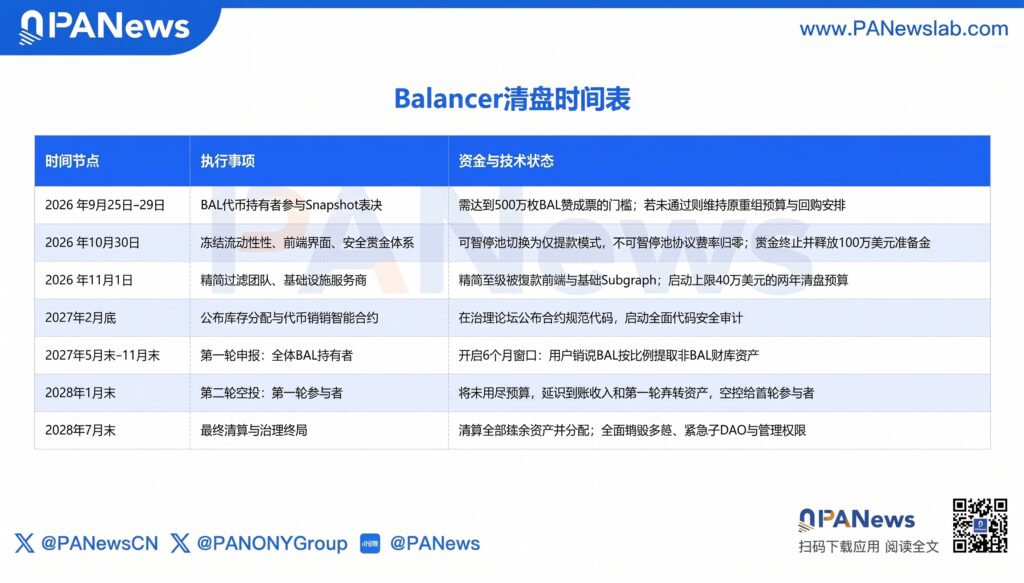
This article covers a proposal reported by PANews on September 15, 2026, not a completed liquidation.
Balancer, once a DeFi protocol with as much as $3 billion in total value locked, faced a basic valuation question: how much of its treasury could be returned to token holders if operations ended? On September 15, Balancer Treasury Council representative Marcus Hardt submitted a governance proposal to stop day-to-day operations and development and begin a wind-down extending to mid-2028.
What would be distributed?
According to the proposal as reported by PANews, the portfolio managed by kpk was worth at least $9 million and consisted mainly of stablecoins, liquid assets and lower-risk yield-bearing positions. Treasury-held BAL would be excluded. Holders who burn BAL in the first redemption round would instead receive a proportional, in-kind distribution of non-BAL assets.
That distinction matters more than the headline comparison with BAL’s approximately $8 million circulating market capitalization at the time. A treasury’s own tokens are not equivalent to external assets available for distribution. Nor does comparing treasury value with market capitalization establish a per-token recovery: eligibility, participation, asset values and the proposal’s implementation would affect the outcome.
The proposed exit routes also differ by token. veBAL locks would be forcibly unlocked into 80/20 BAL/WETH pool tokens; holders would need to exit that liquidity position to obtain BAL for redemption. Holders of auraBAL and sdBAL would need to unwind their positions before the first distribution closes. For permanently locked, non-redeemable tetuBAL, the proposal provides compensation in BAL equivalent to 50% of the amount locked at a snapshot. Any future recovery of previously stolen funds would be reserved for affected liquidity providers, not included in BAL-holder distributions.
Why the operating case weakened
PANews traces the proposed wind-down to the November 3, 2025 exploit of Balancer V2 composable stable pools across several chains. Losses exceeded $128 million; white-hat efforts recovered approximately $28 million. The report also describes liquidity-provider departures and potential legal exposure for Balancer Labs OÜ.
In March 2026, governance reforms BIP-918 and BIP-919 sought to reduce costs and change token economics. The reported plan halved the full-time team, cut the annual budget by 34% to $1.9 million, stopped BAL inflation and veBAL revenue sharing, and directed protocol fees to the DAO treasury. It also promised a voluntary buyback after 12 months, capped at 35% of treasury net asset value. The goal was to reduce the annual deficit from $2.6 million to $700,000 while allowing time for V3 to grow.
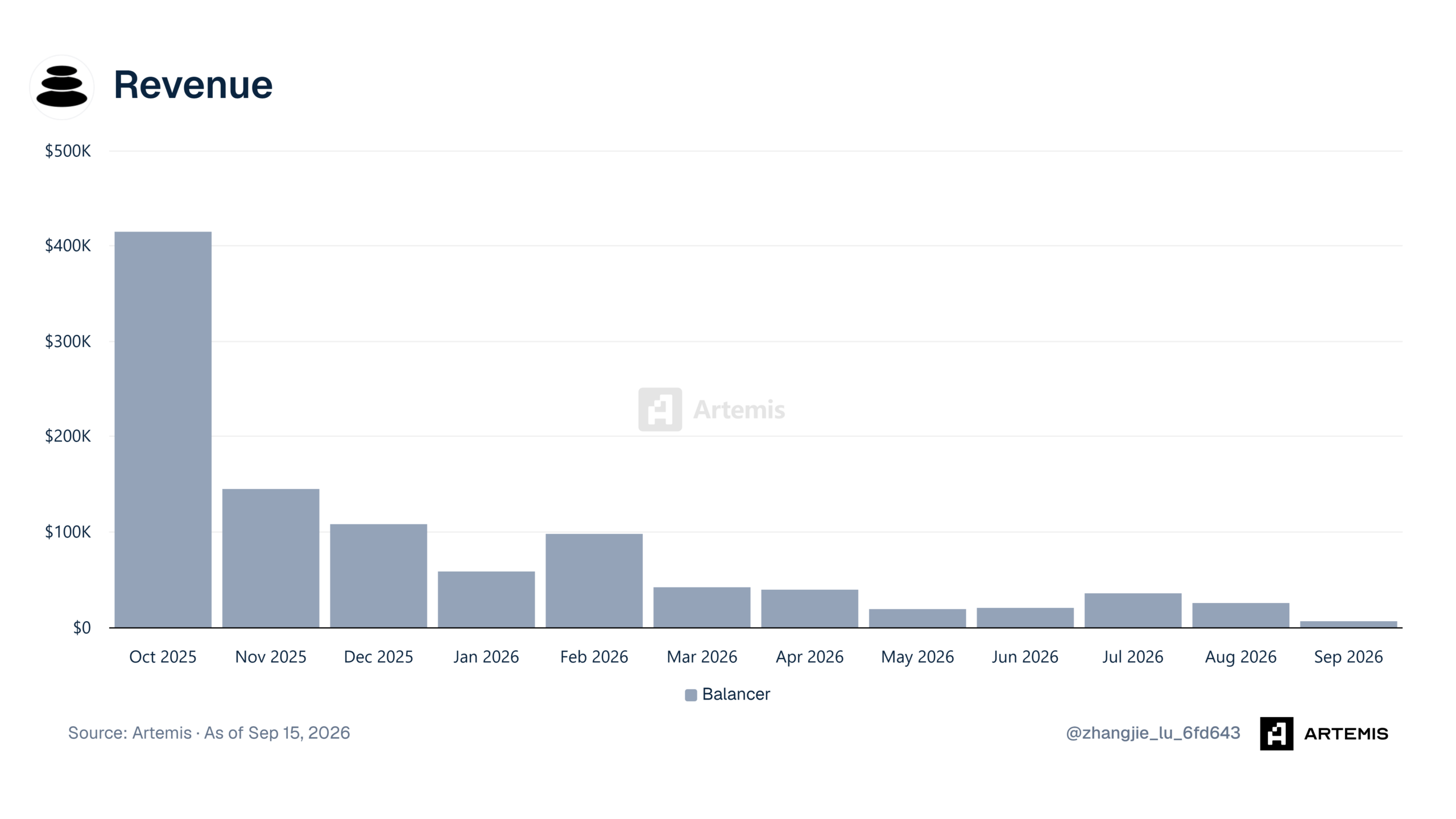
That operating thesis had not delivered by the time of the report. PANews said August 2026 monthly gross protocol revenue was approximately $25,000, against roughly $150,000 in monthly fixed costs. BIP-918 required a revised proposal if monthly gross revenue stayed below $60,000 for three consecutive months. Gross protocol revenue, treasury receipts and value accruing to BAL holders are different measures; the revenue figure alone does not determine what holders would receive.
The proposal would therefore replace a bet on future growth with a staged return of external treasury assets. It was still a governance proposal on the reporting date, and the months-long wait before a planned first distribution in May 2027 would leave holders exposed to asset-price changes and implementation risk.
Source: panewslab.com (originally published 2026-09-15 20:30 UTC+8)