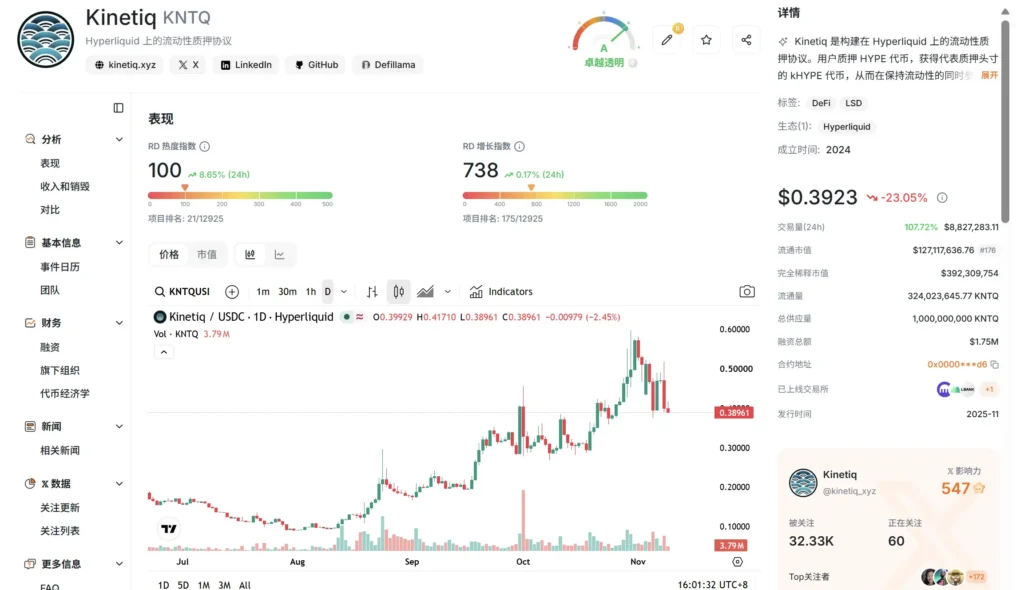
Kinetiq’s Elysium Layer 2 launched its mainnet on November 9, 2026, according to ChainCatcher. For valuation purposes, the distinction is between activity on the network, sequencer revenue and value that may accrue to KNTQ. The launch establishes a proposed link among them; it does not establish how much revenue the network will generate.
The activity Elysium is seeking
Kinetiq, the issuer of the liquid-staking token kHYPE, built Elysium to extend applications around Hyperliquid’s existing trading ecosystem. The intended path runs from token issuance and AMM liquidity to HyperCore’s spot order book and HIP-3 perpetual markets. ChainCatcher reported that Kinetiq’s total value locked exceeded $1.2 billion, but that figure measures Kinetiq’s existing business, not Elysium revenue.
The article describes a gap between Hyperliquid’s perpetual-trading strength and its spot activity. It cites on-chain monitoring indicating that Hyperliquid spot volume relative to Binance had fallen to a 15-month low, while Solana spot volume led by PropAMMs had remained more than 30 times HyperCore spot volume. The source does not name the dataset or give a measurement date for those comparisons, so they should not be treated as current readings.
How network use could reach the tokens
Elysium uses HYPE as its gas token and has no separate Elysium token or points program. Under the plan disclosed by Kinetiq, approximately 50% of sequencer revenue would fund open-market KNTQ purchases and burns, approximately 25% would go to applications bringing traffic to the network, and the remainder would enter Kinetiq’s treasury.
Those are allocation percentages, not revenue forecasts. Transactions would create gas use in HYPE; KNTQ buybacks would depend on sequencer revenue actually being earned and the stated policy being carried out. Neither application announcements nor transaction capacity alone determines the amount available for buybacks. ChainCatcher reported that KNTQ briefly rose 30% on the announcement day, but a price reaction does not measure durable value accrual.
Capacity and launch-stage limits
Built with Arbitrum Orbit and settling to HyperEVM, Elysium targets 300 million gas per second, 30 million gas per block and roughly 100-millisecond canonical block intervals. Its team compared that target with approximately 30 million gas per 60 seconds on HyperEVM and described a 600-fold difference. These are stated specifications and a comparison, not measured demand or revenue.
ChainCatcher reported launch support across trading and application projects, alongside more than ten launchpads announced during the testnet period and thousands of tokens created. It also noted that the initial configuration used a single permissioned sequencer, while permissionless fraud proofs remained a future safeguard. The source warned that purported “Elysium token” presales or points claims were suspicious, given the network’s stated no-token, no-points policy.
The valuation test is therefore observable use: whether Elysium attracts sustained activity, what sequencer revenue that activity produces, and whether the proposed KNTQ purchases follow. At launch, the source provides the mechanism, but not the revenue inputs needed to value its effect.
Source: chaincatcher.com (originally published 2026-11-09 17:47 UTC+8)