Historical report: published November 10, 2026, at 18:00 (UTC+8). The platform and token figures below reflect the dates cited, not current conditions.
The New York Stock Exchange’s planned round-the-clock tokenized-securities platform would use Avalanche technology to settle tokenized-stock trades, according to November 9 reporting by The Wall Street Journal, an Ava Labs announcement and NYSE information cited in the original report. The distinction for AVAX valuation is that using Avalanche technology does not, by itself, make settlement volume a source of AVAX fees. The platform was targeting a fourth-quarter launch and still required regulatory approval.
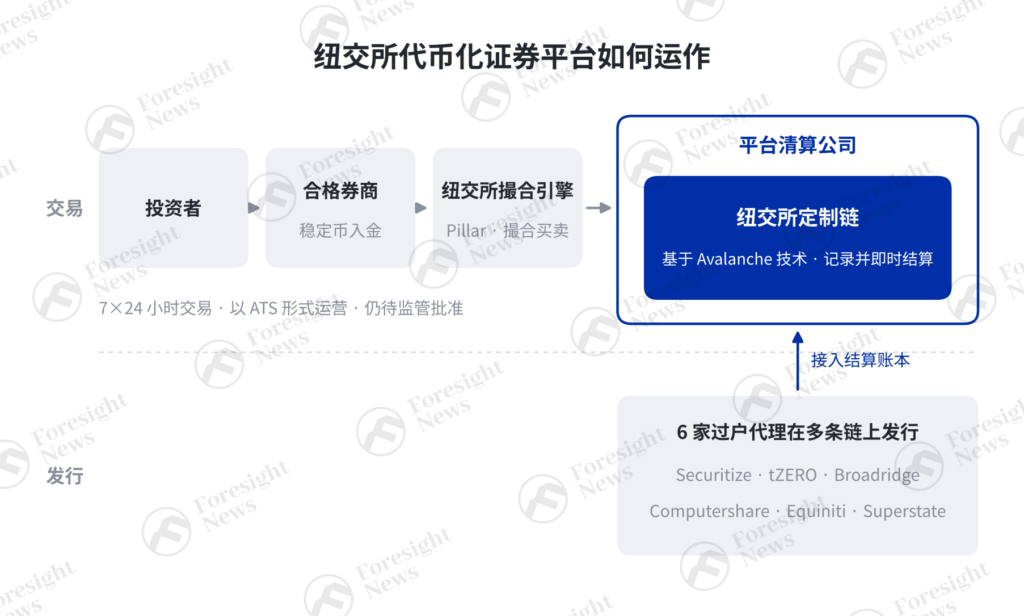
How the proposed platform would work
The platform would operate as an alternative trading system. Under the arrangement disclosed November 9, NYSE’s Pillar engine would match trades, after which the platform’s clearing company would settle them on an Avalanche-based ledger. Investors could fund accounts with stablecoins. Ava Labs chief business officer John Nahas said settlement would take place on a blockchain customized for regulatory requirements, not on Avalanche’s public C-Chain.
NYSE digital issuance head Dennis Lee said stocks could be issued across multiple chains while trading records and settlement would be brought onto that ledger. NYSE had named six transfer-agent partners by November 2: Securitize, tZERO, Broadridge, Computershare, Equiniti and Superstate. According to the reported plan, tokens issued either by custodians or by issuers themselves would be interchangeable with conventional shares and carry the same dividend and voting rights.
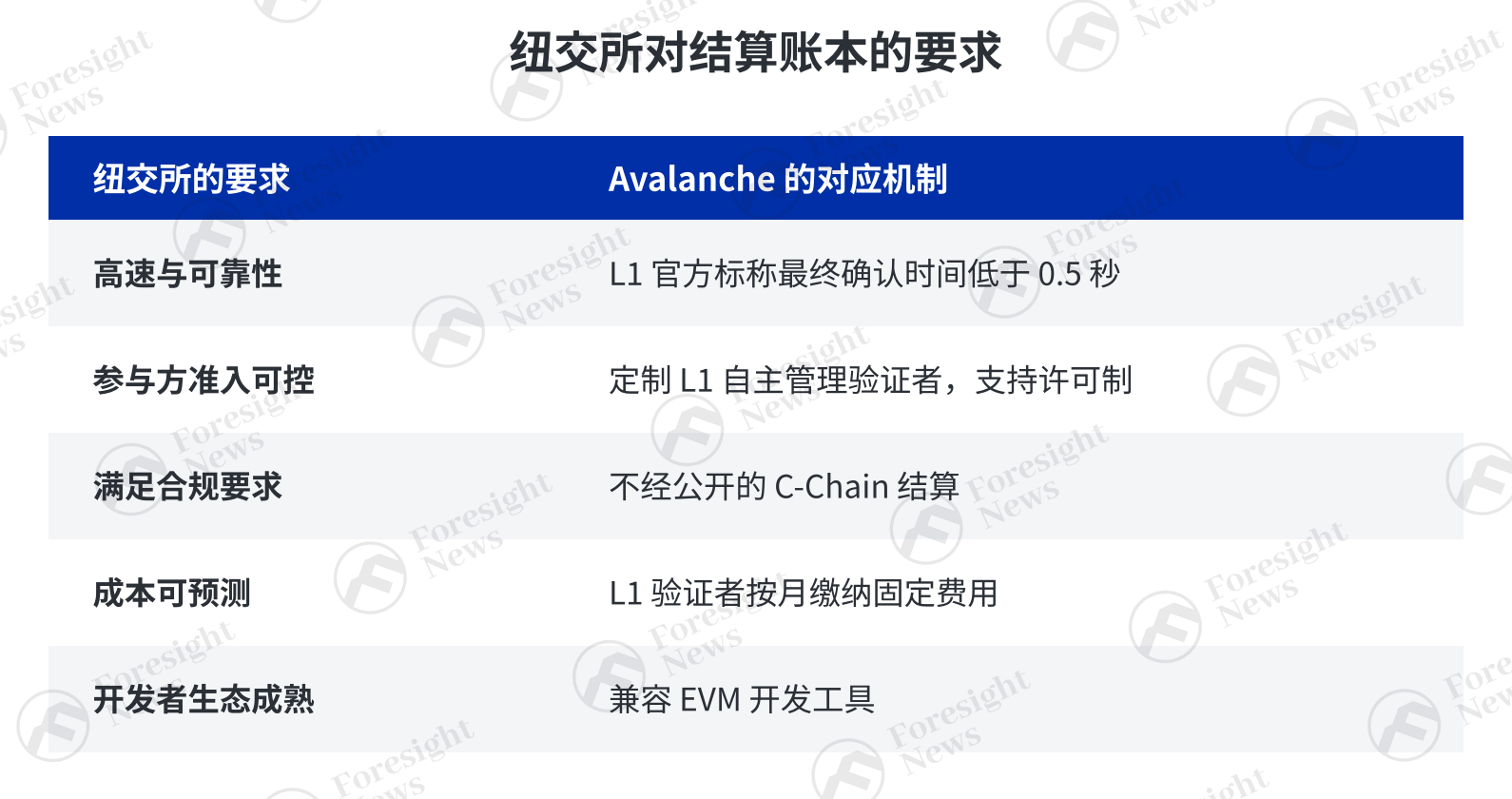
The controlled-participant requirement helps explain the architecture. An institution-operated Avalanche L1 can manage its own validator set and restrict access, unlike the public C-Chain. NYSE chief product officer Kevin Tyrrell said NYSE tested several providers and considered speed, throughput, controlled-network support and compliance capabilities. Lee also cited predictable costs and the developer community.
Activity is not the same as token value capture
Neither the Ava Labs announcement nor NYSE’s statement specified a role for AVAX in this platform’s settlement, transaction fees or staking. Under the Avalanche L1 mechanism described in the original report, validators pay a recurring AVAX fee. Avalanche documentation puts it at approximately 1.33 AVAX per validator per month when there are fewer than 10,000 L1 validators. The payment is burned, but it does not rise with the number or value of settled trades; an L1 can also denominate its internal fees in a token chosen by its operator.
The Avalanche Foundation had already identified this gap. In a July 30 research agenda, it said value created across the ecosystem does not automatically flow to AVAX. Its August 12 estimate put cumulative C-Chain fee burns since early 2024 at about $23.5 million, excluding L1 validator fees. For June—the latest monthly period in that estimate—it reported $3.1 million of nominal on-chain GCP, $2.7 million of returns to holders of assets such as tokenized funds, and $6.9 million of issuer income from reserve assets. The foundation said the latter two categories contributed essentially nothing to AVAX value capture at the time.
Proposals under research included validator-voted gas-price changes under ACP-283, a protocol-owned stablecoin under ACP-67, and revenue sharing from applications and L1s. None was an established revenue-sharing mechanism in the report. For another measure of the existing fee channel, DefiLlama data cited for November 9 put Avalanche C-Chain fees at approximately $26,500 that day.
The broader network’s asset totals describe activity, not AVAX income. RWA.xyz figures cited as of November 9 put freely transferable distributed RWAs on Avalanche at $1.43 billion, ownership-record represented RWAs at $11.4 billion, and stablecoin market capitalization at $795 million. Following the announcement, Bitget prices cited in the report showed AVAX reaching 9.01 USDT and trading at 8.627 USDT at the report’s cutoff, up 6.86% over 24 hours. That price move does not establish how much value the planned settlement chain would deliver to the token.
Source: odaily.news (originally published 2026-11-10 18:00 UTC+8)