Original publication: November 2, 2026, at 21:36 (UTC+8). The figures and assessments below are those presented in the source at that time, not updated measurements.
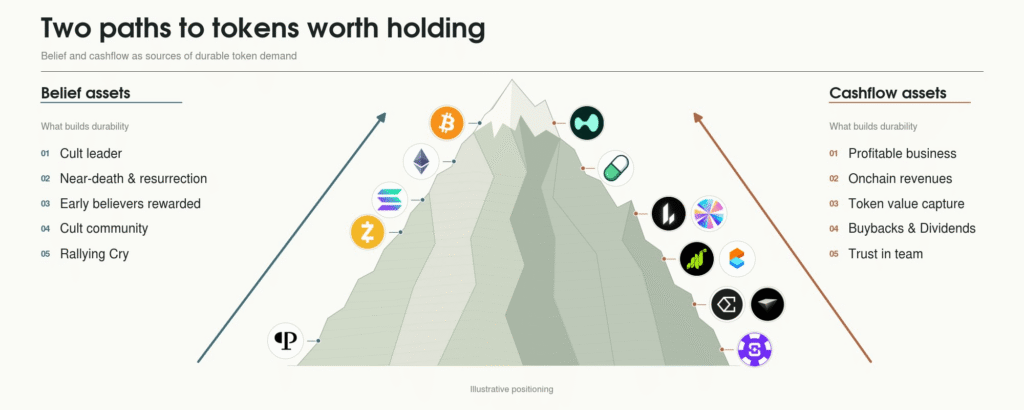
A token can attract trading without giving anyone a durable reason to hold it. In an essay by tzedonn, translated by 白话区块链, the author proposes two ways to examine lasting demand: the strength of shared belief in an asset, and the credibility of the economic value its holders can capture. Neither is, by itself, a valuation model or a price target.
Assets sustained by belief
Some tokens provide no cash flow to holders. Their value instead depends on a sufficiently durable consensus that they are worth owning. The author argues that enduring examples tend to develop recognizable figures, survive crises, reward early supporters, build a distinct community identity and acquire a memorable description of their purpose.
The essay uses BTC, ETH, SOL and HYPE to illustrate those traits, while contrasting them with shorter-lived memes such as WIF and BONK. It also describes ZEC as approaching several of the traits, citing its survival of a shielded-pool vulnerability and a reported rise from $40 to $1,200 within a year. These are the author’s comparisons, not evidence that any asset will retain demand. The author describes PRL, dubbed “AI Bitcoin,” as an early bet on whether such a following might develop.
Assets supported by cash flow
The second route starts with an operating business, but business revenue is not the same as token-holder value. The essay’s framework asks five separate questions:
- Economic surplus: Does the business produce sustainable profit, rather than merely activity or gross revenue? The author says HYPE and PUMP each generated roughly $1 million–$2 million in daily revenue throughout the year. The article does not supply a dated dataset, expense figures or a calculation of free cash flow from that revenue.
- Verifiability: Can the reported economics be checked on-chain? The author contrasts the more observable revenue of HYPE and PUMP with GRASS’s off-chain private contracts, whose proceeds require greater trust to assess.
- Token versus equity: Which claim receives the economic benefit? The essay cites SHFL as a cautionary example: it says a Curaçao-registered equity entity received $18 million in dividends while token holders received a lottery ticket. It also raises questions about the relationship between equity and token value at Venice and GRASS.
- Value capture: Is there an enforceable or automated route from surplus to the token? In the author’s view, on-chain buybacks or distributions such as those attributed to HYPE, LIT and SKY offer more certainty than discretionary buybacks such as PUMP’s. A buyback mechanism still needs to be assessed separately from the revenue used to fund it.
- Trust during reinvestment: If a team retains profits for growth, what assures holders that they will eventually benefit? The author places GRASS, ENA, CHIP and CARDS in this category and notes that token holders generally lack the legal rights, board oversight and audited accounts familiar to equity investors.
The essay groups HYPE, LIT, PUMP and SKY among its strongest cash-flow-token examples. That grouping does not erase the distinction it draws between automated and discretionary buybacks. It also discusses PAPER as a proposed token design that was abandoned because it could have enabled attackers to extract trading-platform profits. Its examples involving a potential Polymarket token and a hypothetical on-chain Shuffle casino are scenarios, not existing token-holder cash flows.
The central valuation distinction is therefore between a business earning money, a verifiable surplus after its costs, and a credible claim by token holders on that surplus. The author’s preference for HYPE rests on a further judgment that it may combine cash-flow capture with durable belief. Whether either source of demand persists—and how much of any business value reaches the token—remains the question an investor would have to test, not a conclusion established by the token’s price or revenue alone.
Source: hellobtc.com (originally published 2026-11-02 21:36 UTC+8)