The valuation question raised by two tokenized-stock plans reported on November 9, 2026, is not whether blockchains will be used. It is how much of that activity could create demand for AVAX or SOL. The plans differ sharply on that point, and neither establishes a large new revenue stream for token holders.
Avalanche: a dedicated ledger, limited AVAX demand
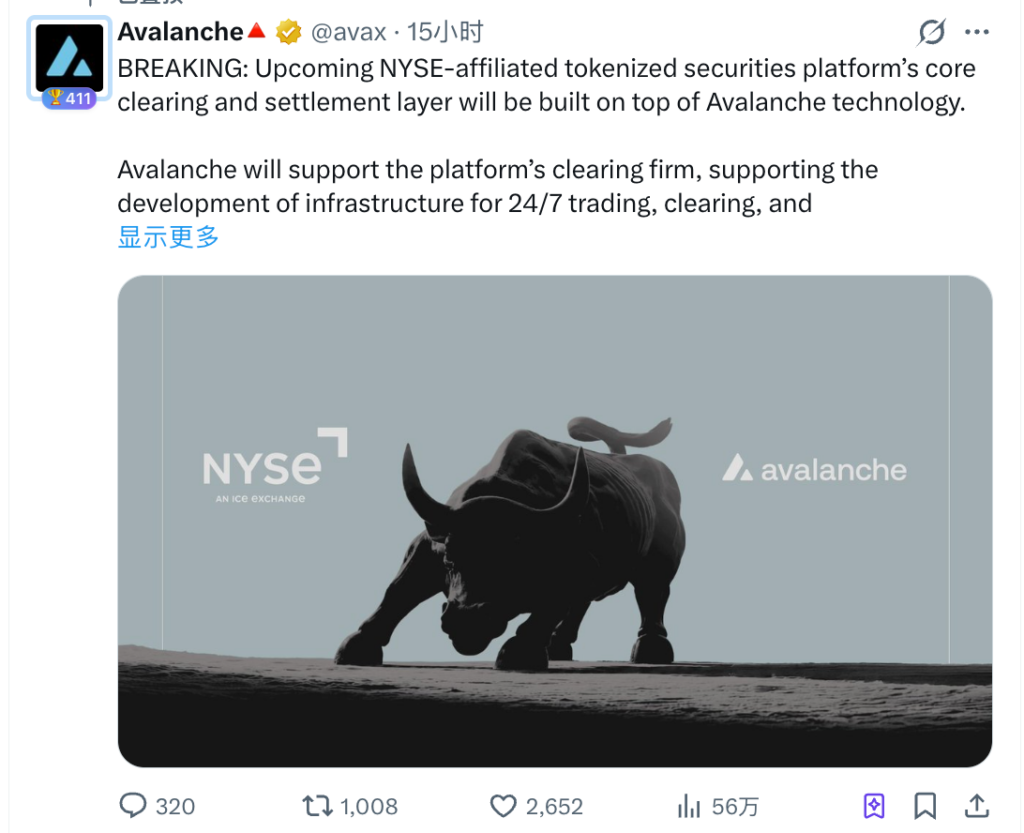
Ava Labs said the New York Stock Exchange’s planned tokenized-stock platform had selected an Avalanche-based ledger for clearing and settlement. The proposed round-the-clock platform still required regulatory approval. TechFlow reported that AVAX moved from $7.82 to $8.85 that day, describing its peak gain as about 10%; it also reported a roughly 26% rise in open interest, with Binance and Bybit accounting for 77% of that increase. Those market moves do not measure future token demand from the platform.
According to the report, NYSE chose a dedicated chain configured to meet its requirements, rather than the Avalanche public chain. NYSE would control institutional access and validator operation. The distinction matters because the chain’s activity need not generate substantial AVAX transaction fees.
Before Avalanche’s December 2024 Etna upgrade, validators on such dedicated chains had to stake 2,000 AVAX each. The report says that requirement was replaced by a payment of approximately 1.33 AVAX per validator per month, which is burned; transaction fees can be paid in a chain’s own token. At that rate, a hypothetical 30-node NYSE deployment would burn fewer than 480 AVAX annually. TechFlow valued that at roughly $4,000 at the price it used, against an AVAX market capitalization of approximately $3.9 billion. The 30-node deployment is an illustration, not a disclosed NYSE configuration. TechFlow also cited a September VanEck estimate that roughly 850 such nodes would collectively pay the main network about $160,000 per year.
Solana: public-chain transactions, capped volume
On the same day, Formation Securities notified the US Securities and Exchange Commission of a plan to operate a tokenized-stock venue on Solana, targeting an early-2027 launch. TechFlow described Formation Securities as the securities arm of Formation, created after Solana protocols Orca and Loopscale merged in October 2026; the venue would license trading technology from Orca.
Under the proposed design, participating companies would authorize tokenization through issuers Superstate and Securitize. Identity-verified investors could hold the shares in their own wallets and trade around the clock using stablecoins. Shares and payment would settle in one Solana transaction; the tokens would retain ordinary-share dividend and voting rights and could be used in approved on-chain applications. The initial plan covered three companies. Unlike the NYSE arrangement, each trade on the proposed venue would be a public Solana transaction with fees paid in SOL.
Formation cited speed, low cost and more than $5 billion in tokenized real-world assets already on Solana. TechFlow also noted that Orca, Superstate and the Solana Policy Institute had submitted a public-chain stock-trading proposal to the SEC in April 2025. The report linked Formation’s approach to an SEC innovation exemption issued on September 17, 2026, which it said required trading contracts to be deployed on a public chain.
The reported exemption also limits the addressable volume. For large-cap stocks such as those in the S&P 500 or Russell 1000, a venue could trade at most 75 names, and on-chain trading in each name could not exceed 0.25% of its prior month’s average daily volume—one share in 400. The limit for other stocks was 2.5%; a second breach would trigger a three-month suspension. A Solana transaction fee of less than one cent, combined with those volume limits, constrains the potential fee opportunity. It does not, by itself, establish a valuation for SOL.
The three stocks planned for launch were Exodus, Forward Industries and Galaxy. TechFlow identified Exodus as a crypto-wallet company, Forward as a Solana treasury company holding about 8.5 million SOL, and Galaxy as one of Forward’s backers. Their involvement shows initial participation, not broader demand from listed companies.
The valuation distinction
The plans offer different paths to token demand: a small, specified AVAX validator payment on a dedicated chain versus SOL fees on public-chain trades subject to regulatory volume limits. Neither a price reaction nor adoption of blockchain settlement is a substitute for measuring those flows. For context, TechFlow reported that AVAX rose about 12% to $11.92 after a Goldman Sachs Treasury fund connected to an Avalanche dedicated chain on September 29, then fell back near $7.80 over the following six weeks. That historical move illustrates price sensitivity to announcements; it does not establish the outcome of the NYSE plan.
Source: techflowpost.com (originally published 2026-11-10 12:40 UTC+8)