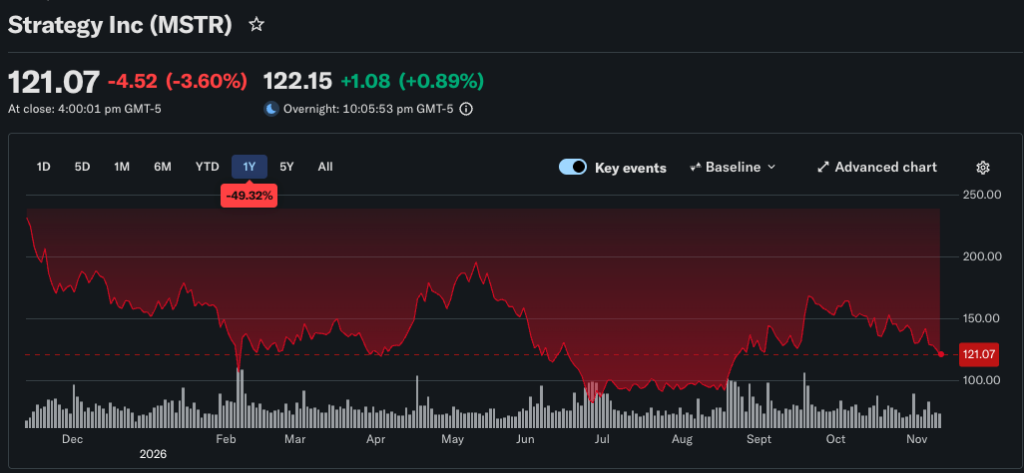
Historical reporting context: This article reflects information available in the original report published on November 11, 2026, at 15:53 Beijing time. The MSCI decision discussed below was still pending at that point.
The index decision and the estimated selling
MSCI’s revised screening method could remove Strategy from its Global Investable Market Indexes. Strategy appeared on a preliminary deletion list, with the final result expected after 06:00 Beijing time on November 12. A preliminary listing was not a confirmed deletion.
The proposed selling estimates concern MSTR shares, not Strategy’s bitcoin. Strategy estimated that passive funds tracking the relevant index held about 13 million MSTR shares, or 3.1% of its shares outstanding. At the report’s quoted share price of $121.07, that stake was worth approximately $1.57 billion. A JPMorgan scenario that included other benchmark-linked investors put potential departures as high as $2.8 billion. Neither figure is a forecast of sales at a particular price: fully replicating funds and funds using other tracking methods may trade differently, and other buyers could absorb some of the supply. If Strategy were removed, the report said affected funds would rebalance by the November 30 close.
Why Strategy was under review
MSCI’s method screens companies whose value comes principally from holding assets rather than operating activities. It first examines operating assets, then applies financial tests that include operating expenses, operating cash flow, fair-value changes and reliance on external financing. For an existing constituent, MSCI requires a failure across the two most recent annual reporting periods before deletion.
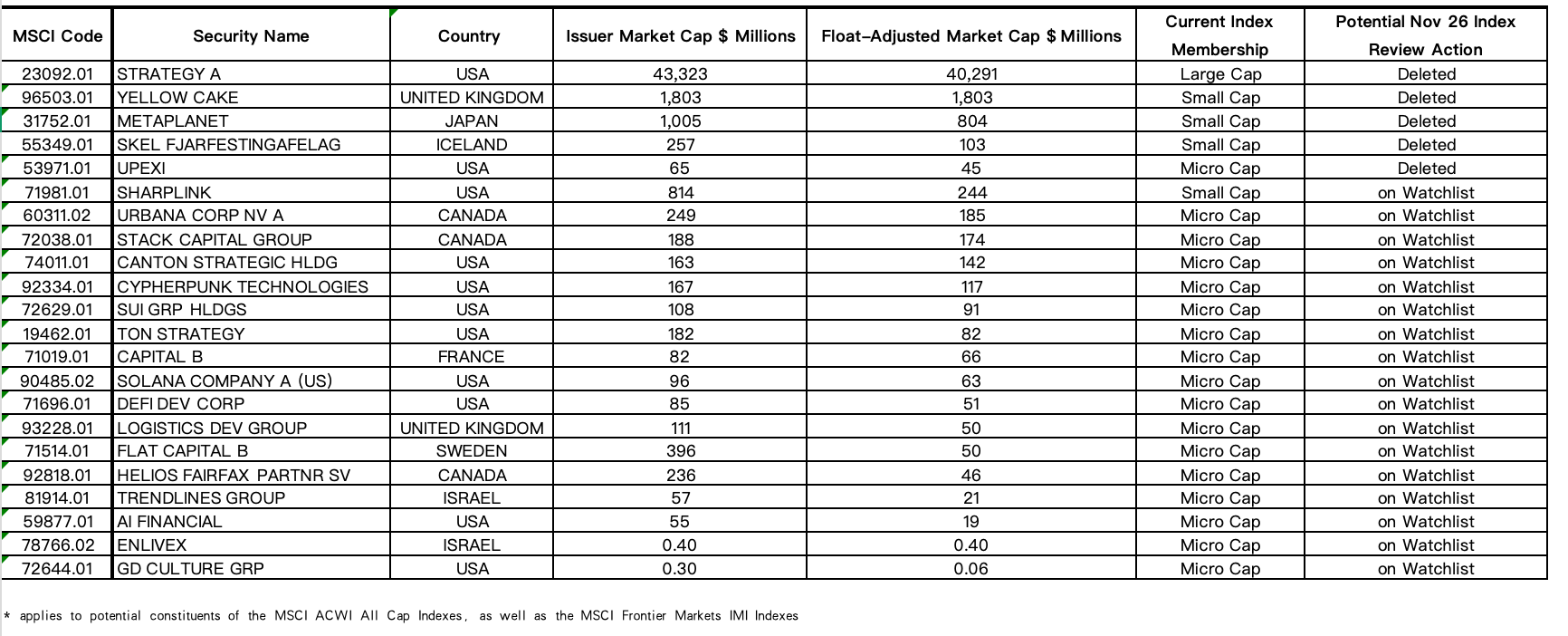
Of 22 companies identified as potentially affected, 14 were directly related to crypto. Strategy, Metaplanet and Upexi were among five proposed deletions; the other two were uranium investor Yellow Cake and investment holding company SKEL. Eleven other crypto-related companies were on a watchlist. Strategy objected that it still operates a software business and reports its bitcoin business as an operating segment. MSCI said the screen applies to companies with financial characteristics resembling investment vehicles, not only crypto holders.
The valuation channel is indirect
Strategy disclosed on November 9 that it held 850,364 bitcoin as of November 8, acquired for approximately $64.16 billion in total. The report quoted MSTR at $121.07 at the November 11 U.S. close, down 3.60% for that session and about 6.4% below its November 5 close of $129.30.
The relevant valuation question is whether pressure on MSTR would weaken Strategy’s ability to finance additional bitcoin purchases. When its shares trade at a premium to the net asset value of its underlying bitcoin, selling new equity can raise cash for purchases. A lower share price would raise less per share sold; issuing more shares to raise the same amount would dilute existing shareholders. Financing costs through other instruments could also change. The report says Strategy sold 2.05 million MSTR shares for $283.8 million during November 2–8 and used $81.9 million to buy 1,036 bitcoin.
That is a possible path from an index decision to future demand for bitcoin, not a direct sale of bitcoin by an index fund. Removal alone would not establish that Strategy must sell its holdings, or provide a basis for calculating a bitcoin price move. The report also notes that Strategy had used approximately $431.8 million in proceeds from bitcoin sales that year to support preferred dividends and STRC repurchases, while continuing to buy bitcoin. As of November 8, it reported about $4.77 billion in a dollar reserve for preferred dividends and debt interest, plus $146.2 million in cash available for broader corporate purposes.
Source: odaily.news (originally published 2026-11-11 15:53 UTC+8)