A TechFlow compilation of Coin Metrics research by Cooper Duschang, published on 11 November 2026 in the State of the Network series, asked a mechanical valuation question: what company value were crypto pre-IPO perpetual contracts assigning to Anthropic, and which share-count rule turned that value into a contract price?
The note is not a fair-value model and does not produce a target price. It separates three layers that the quotes were mixing: derivative positioning (open interest and where it sat), an implied equity value, and the denominator used to convert that value into a per-share mark. These contracts reference Anthropic shares, not a protocol token, so protocol activity, protocol revenue and token-holder accrual are not inputs.
As of that 11 November 2026 note, Anthropic had made its S-1 public on 26 October 2026. A listing was then expected the following week. The note does not report that listing as completed. Class A common stock was the class planned for the public offer and the unit that would be quoted on Nasdaq after listing. The note does not place the shares on the NYSE.
What was being measured
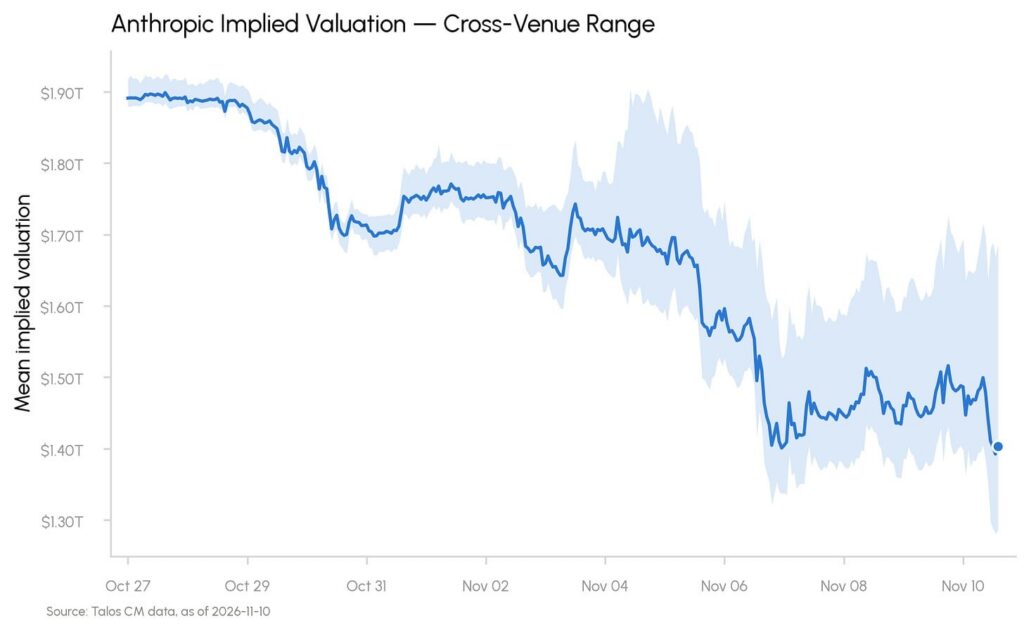
Across the pre-IPO venues in the study, Coin Metrics put the implied valuation center near $1.4 trillion, down from earlier highs above $2 trillion. The team linked a further markdown in expectations to the S-1 disclosure of a share count and an expected offer range of $70 to $78. The latest amended S-1 put fully diluted shares at about 18 billion. The $1.4 trillion figure is a cross-venue reading from Talos CM Market Data Pro, not a cash-flow result, and the note does not treat it as a conclusion about fundamental value.
One chart covers 27 October through 10 November 2026 and shows implied mean valuation together with the cross-venue price range for Entropy, Binance, Bitget and Gate.io.
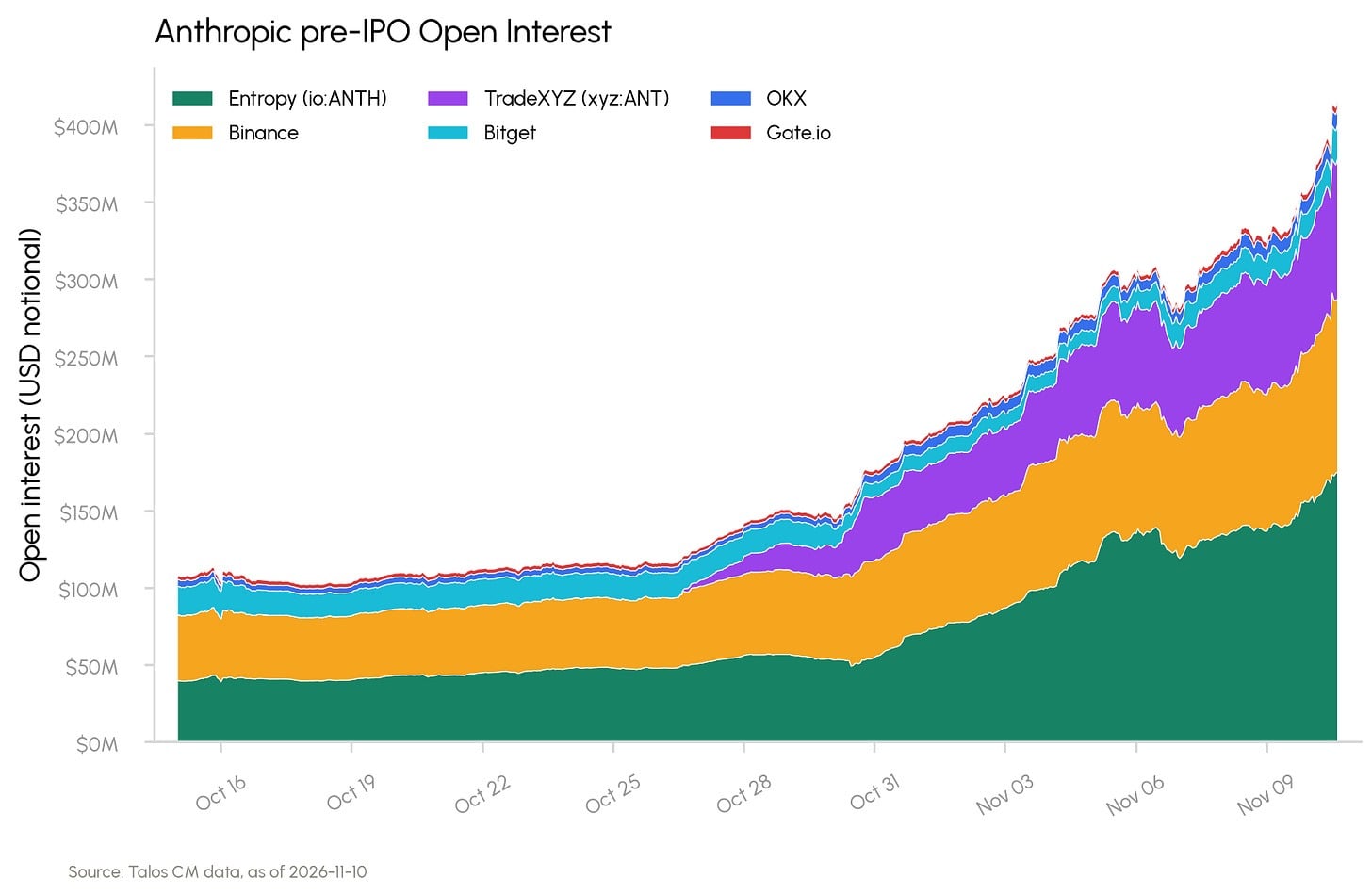
Open interest describes positioning, not the value of the company. As of 10 November 2026, open interest linked to Anthropic on Entropy, TradeXYZ and OKX together exceeded $260 million. A second Talos CM Market Data Pro chart tracks that open interest from mid-October through 10 November on Entropy, Binance, TradeXYZ, Bitget, OKX and Gate.io.
Before the S-1, OKX was the only venue quoting Anthropic on a per-share basis. Other platforms mostly quoted total market value. After the filing, Hyperliquid HIP-3 builders TradeXYZ and Paragon also listed per-share markets. The denominator comparison below is the one Coin Metrics builds for TradeXYZ, OKX and Entropy.
Three denominators, three prices
Most Anthropic pre-IPO contracts were still anchored to company value. The note’s premise is that, once the shares listed, those contracts would have to switch to a per-share price. Quotes might eventually meet the publicly traded ANT share, but the venues did not use the same path. Unmatched settlement rules are what the note identifies as the source of cross-venue gaps.
TradeXYZ uses Class A only. TradeXYZ deployed its market the day the S-1 was released. From 26 October, open interest exceeded $65 million and, in less than four days, reached four times the OKX position. The contract was opened at $125 with a price-discovery band of plus or minus 50%. Each contract is defined as one Class A common share. Unexercised options, restricted stock units and other classes are excluded. That is the narrowest denominator in the set, which is why the note uses TradeXYZ as the reference anchor.
The S-1 offering plan was for 825 million shares at $70 to $78. As of 10 November, xyz:ANT on TradeXYZ was about $97. The note describes that quote as about 23% above the $78 top of the range. A heatmap, sourced to Talos CM Market Data Pro and the SEC S-1, maps company value under alternative share counts against the $70–$78 band. Those cells are not restated here.
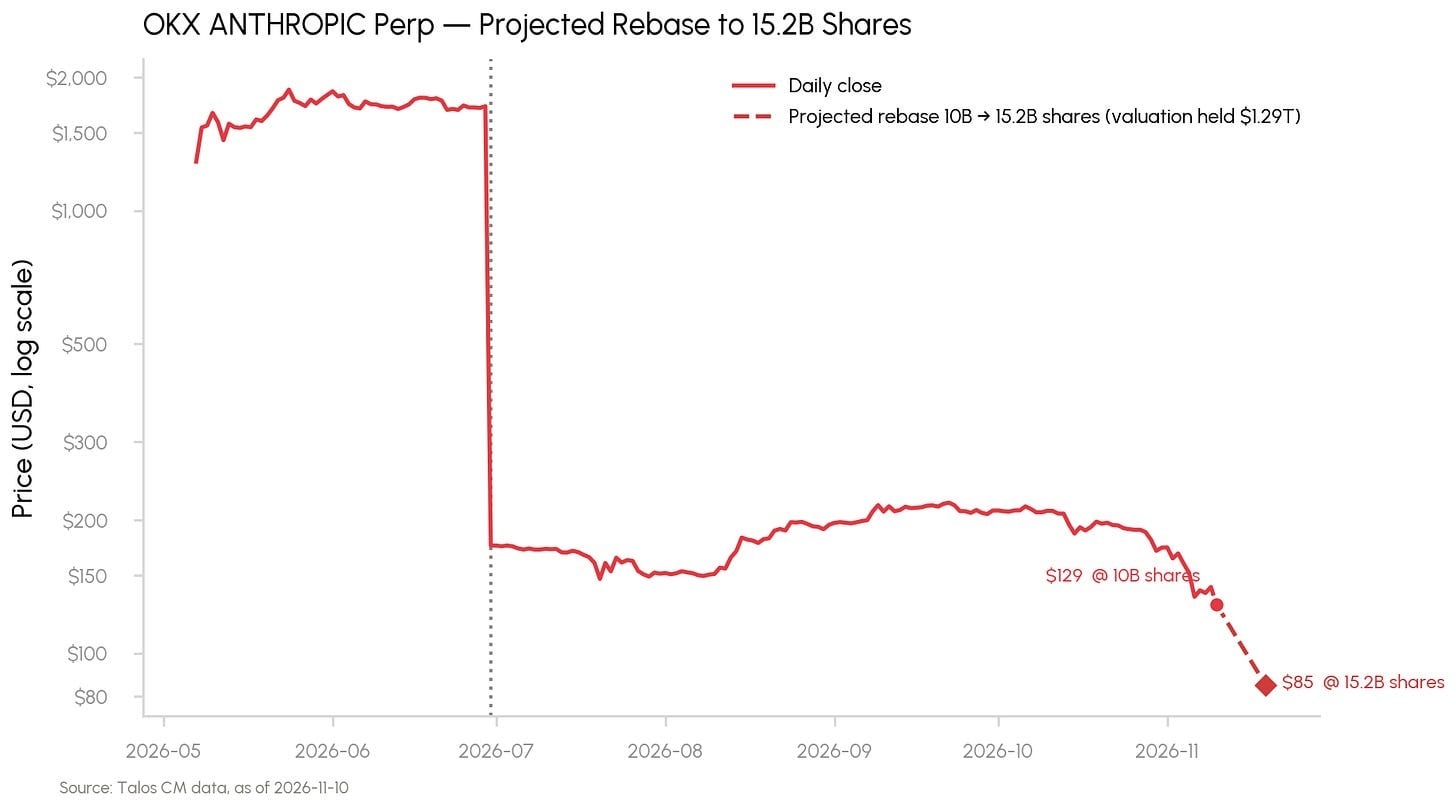
OKX uses Class A plus Class N common stock. OKX had listed a per-share Anthropic market in May 2026. It started with a denominator of 1 billion shares, so a contract price of $1,500 implied $1.5 trillion. On 30 June 2026 it rebased the count from 1 billion shares to 10 billion. Position notional was left unchanged and the contract price was cut to one-tenth.
A further rebase was still expected, to match common shares outstanding immediately after the IPO. Under OKX’s rule, a rebase force-settles realized profit and loss, resets the parameters and then reopens trading. The final count includes Class A and Class N common stock issued at that point and excludes unexercised options and unvested RSUs. The amended S-1 puts that figure at about 15.2 billion shares, wider than TradeXYZ’s Class A-only base. The note therefore expected OKX’s per-share delivery price to converge downward toward the TradeXYZ anchor. Its chart shows historical OKX ANTHROPIC perpetual closes and a theoretical path after a simulated second rebase on 15.2 billion shares (Talos CM Market Data Pro and OKX). That path is a simulation, not a rebase the note reports as already executed.
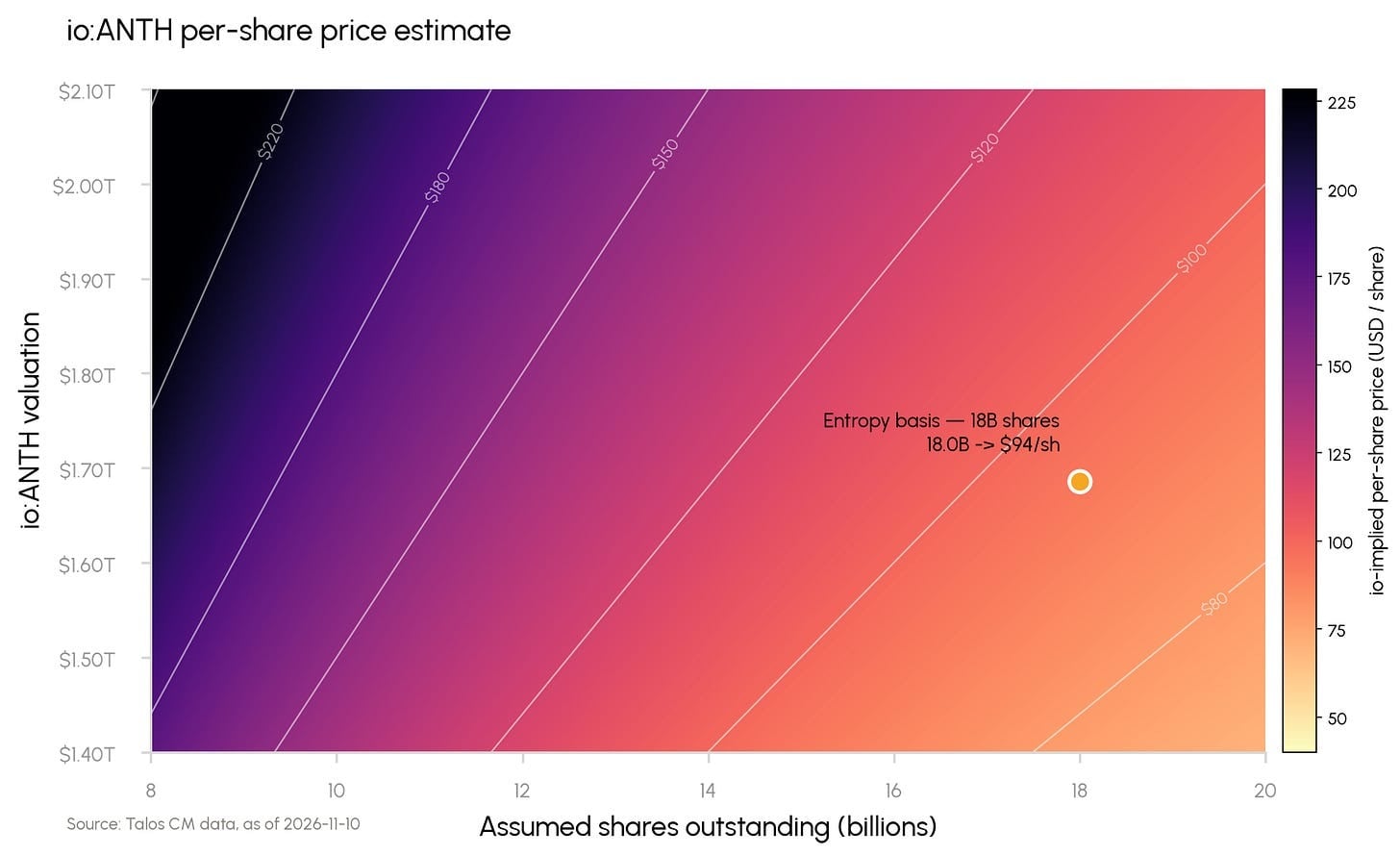
Entropy uses fully diluted shares. Entropy, also a HIP-3 market, prices from total equity value rather than from a share quote. From its August 2026 launch to the note’s cutoff, open interest exceeded $175 million, the largest book in the comparison. At the switch to a listed-stock contract, Entropy divides equity value by fully diluted shares: Class A, Class N, unexercised options and unsettled RSUs. Spreading one company value over the widest count produces a lower per-share price. The note treats the gap versus other venues as dilution already in the quote. A sensitivity matrix for io:ANTH, from Talos CM Market Data Pro and the SEC S-1, maps the 18 billion share case to about $94 a share. On the book at the time, Coin Metrics read Entropy’s price as implying about a 20% first-day gain relative to the offer range. That is a translation through Entropy’s own rule, not a forecast.
Earlier Coin Metrics work on Entropy’s Anthropic market had described deep Hyperliquid perpetual liquidity and tight spreads, competitive with large centralized exchanges. This 11 November note does not restate those spread figures.
Index beta, and what the SpaceX case did and did not show
The note also asks how closely the pre-IPO contract moved with equity indices. It treats a low beta as a sign that the link to the stock market was still incomplete.
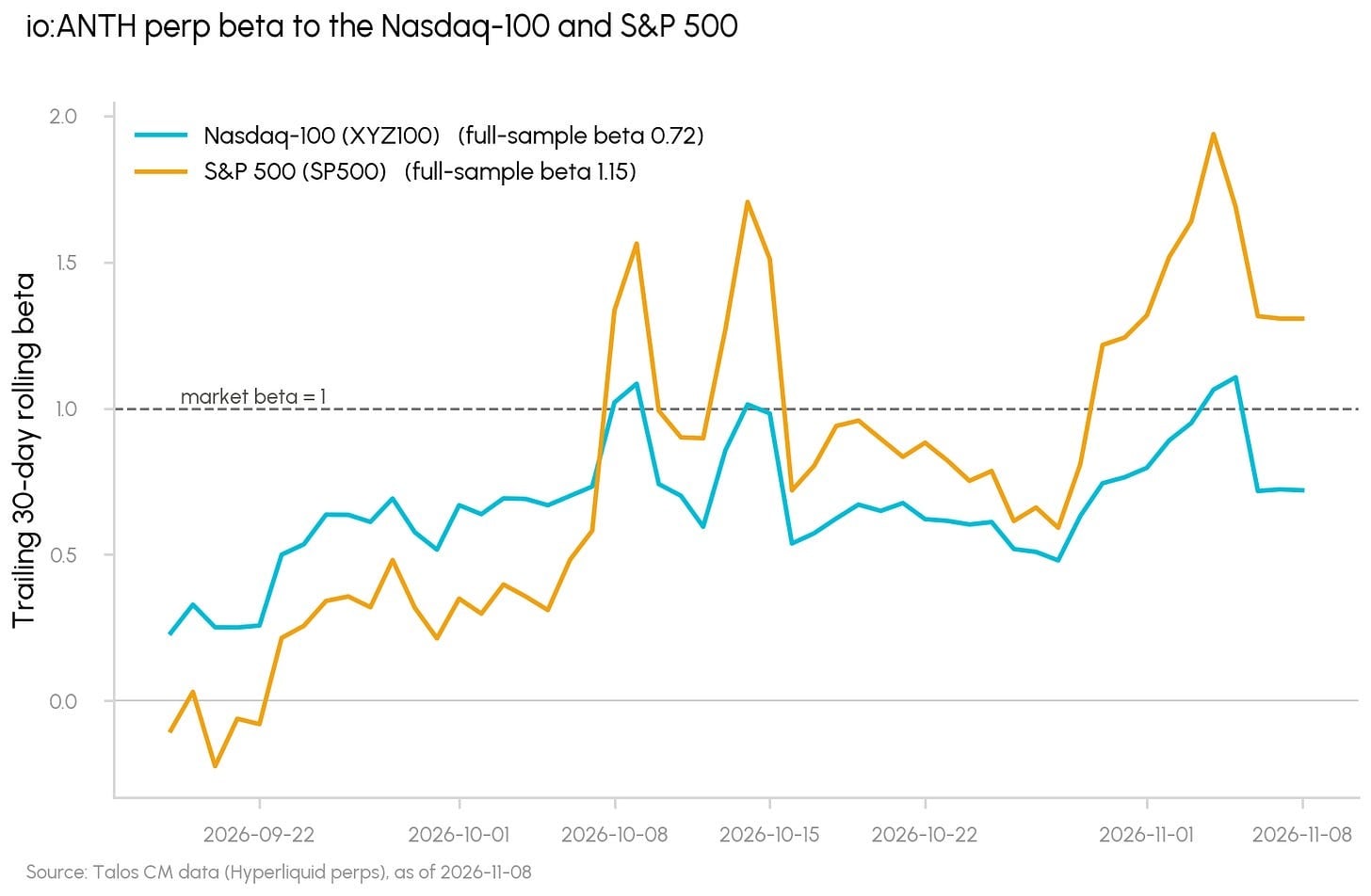
On Talos CM Market Data Pro, the full-sample beta of io:ANTH to the Nasdaq 100 (QQQ) was 0.72, and the full-sample beta to the S&P 500 was 1.15. The published chart is a 30-day rolling beta from mid-September through 8 November 2026. Sensitivity to the broad index was higher than sensitivity to large-cap tech. The authors read that split as the market still waiting to see how specific events would pass into the valuation.
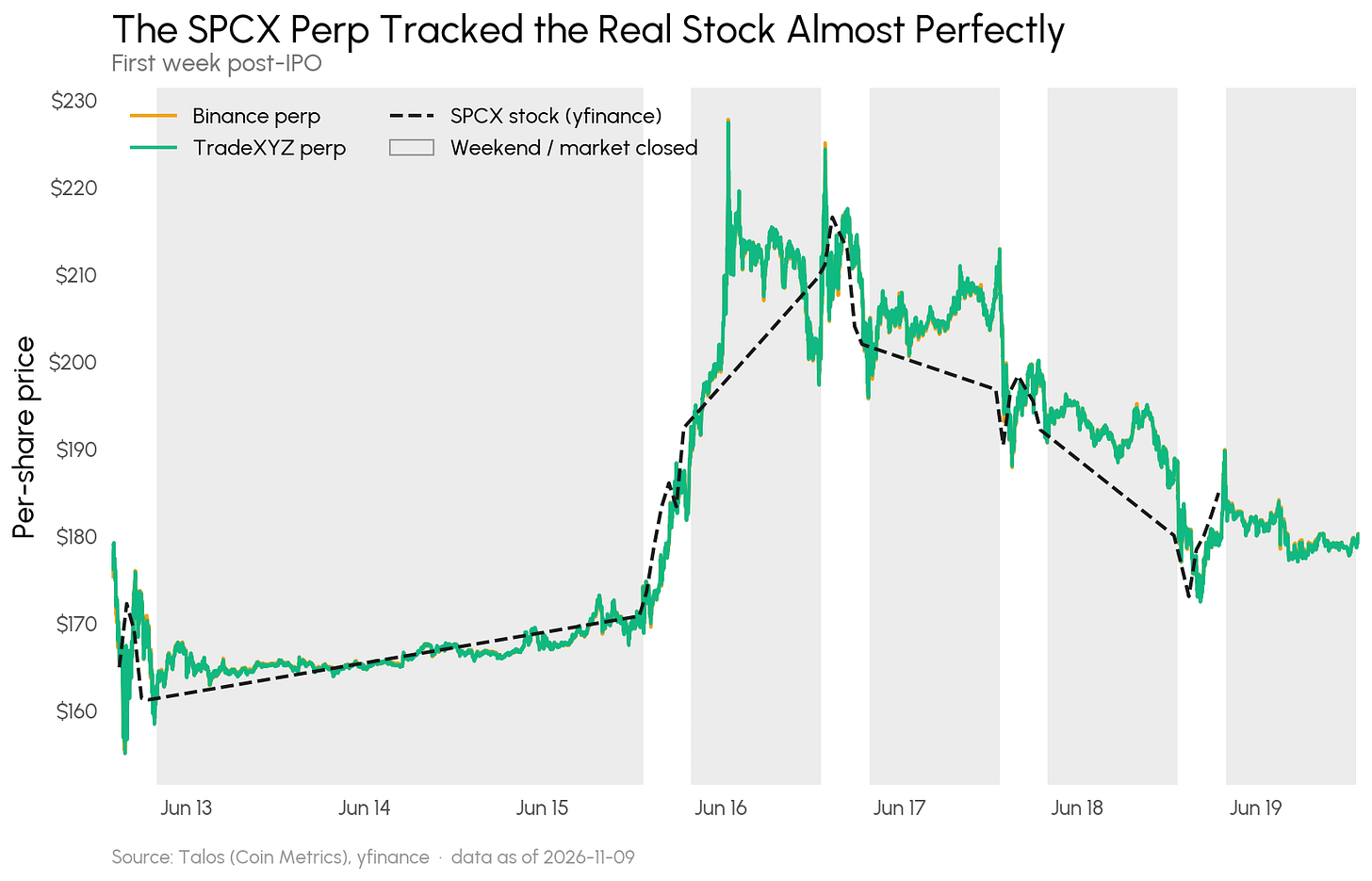
SpaceX is the precedent the note actually measures, not a path it assigns to Anthropic. Before SpaceX listed, SPCX betas were 0.22 versus QQQ and 0.45 versus the S&P 500. After the listing they rose to 1.43 and 1.97. The IPO price was $135. Pre-IPO perps had traded near $176. Even after allowing for the first-day move, the note says the pre-market contract was still about 17% above the actual open, and that the contract then moved toward SPCX stock. During regular US equity hours one week after the SpaceX listing, the spread between SPCX perps on Binance and TradeXYZ and the underlying share stayed inside 2% (Talos CM Market Data Pro and Yahoo Finance).
The note’s claim for price discovery is limited. Those contracts gave ordinary on-chain traders a way to trade the first-day premium usually associated with a traditional IPO. They did not fix the opening print: the SpaceX pre-market was high of the open, then converged.
What the inputs do not settle
Read as of 11 November 2026, the argument has a clear order. Open interest, above $260 million on Entropy, TradeXYZ and OKX combined, says where exposure sat. About $1.4 trillion is an implied company value across pre-IPO quotes, already below the prior peak above $2 trillion. The per-share marks are that conversation run through different divisors: about $97 on TradeXYZ’s Class A contract, a lower delivery price expected once OKX used roughly 15.2 billion Class A-plus-N shares, and about $94 where Entropy’s matrix applied roughly 18 billion fully diluted shares. Until the settlement rules match, a cross-venue gap is a denominator effect. It is not evidence that one book is cheap or expensive.
No fair-value target follows. The offer range, the three share counts and the SpaceX tracking error are the limits the note itself places on reading a pre-IPO perpetual as the stock.
Original article, published 11 November 2026: TechFlow compilation of the Coin Metrics note. Research is attributed to Cooper Duschang, Coin Metrics; the Chinese compilation is by TechFlow. Figures above are as reported there from Talos CM Market Data Pro, the SEC S-1, OKX and Yahoo Finance. Measurement windows end on or before 10 November 2026 unless a chart date in the note says otherwise.