A November 11, 2026 TechFlow compilation of Spencer Applebaum’s Multicoin essay frames a valuation question rather than a product announcement: once AI makes protocol code cheap to write, which inputs still let a DeFi business keep pricing power, and which of those inputs actually reach token holders?
The contrast in build cost is explicit. Five years earlier, a DEX or lending protocol typically meant raising $3 million, hiring five engineers, and spending six months on a minimum viable product. By the time of the essay, a founder using a tool such as Claude Code could assemble most of the framework over a weekend, and a frontier model could generate a matching engine, risk engine, trading interface, API, and most other core pieces of a perpetual-futures exchange. Applebaum’s claim is not that every financial business becomes a commodity. A model can write a lending protocol in an afternoon. It cannot produce $10 billion of stablecoin deposits flowing into that contract, or 28 million customers for a new internet broker. Loyal users, a large balance sheet, and proprietary underwriting data still take years of relationships, a track record, and trust.
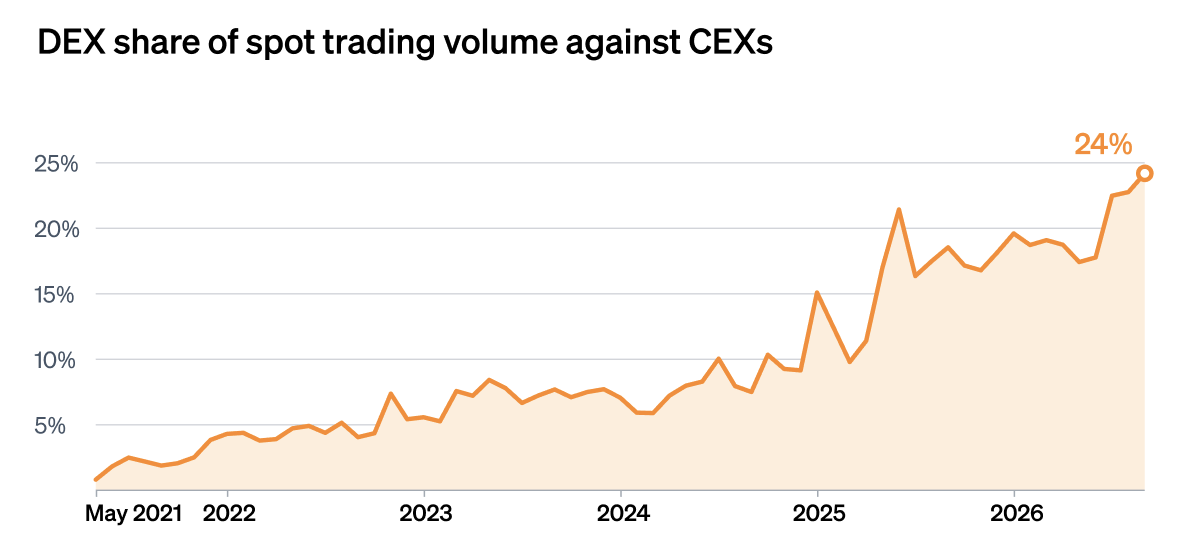
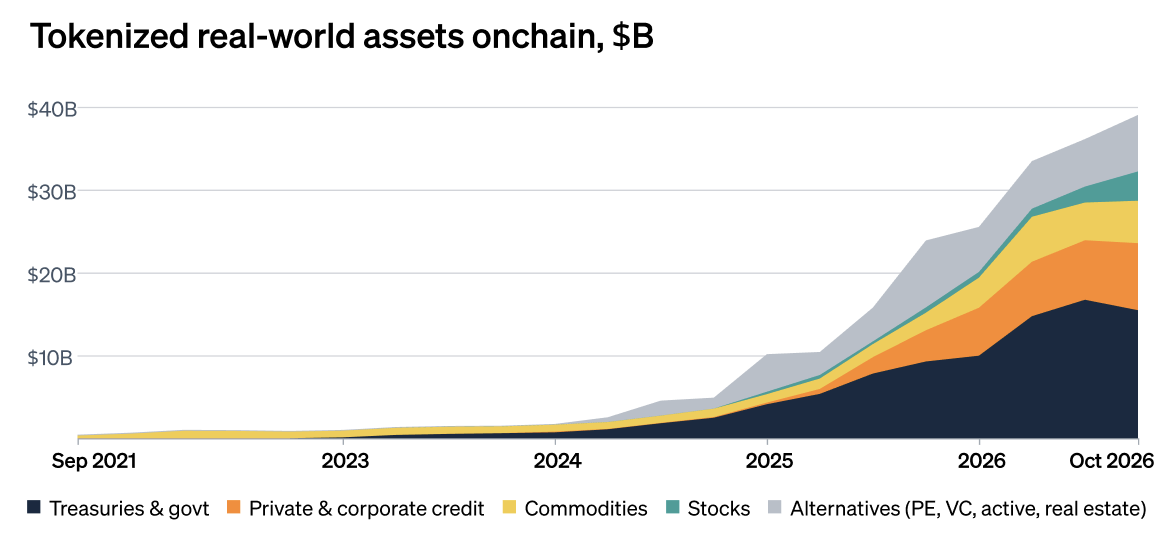
The essay’s premise is that DeFi keeps absorbing centralized crypto venues and, later, parts of traditional finance. It reports DEX spot volume as a share of CEX volume at a then-recent high of 24 percent and still rising, citing The Block and DefiLlama. It also reports real use of tokenized Treasuries, private credit, and equities, with growth no longer limited to crypto-native users. Traditional firms, fintech companies, asset managers, and brokerages were building onchain products and bringing existing clients with them; the tokenized real-world-asset stock is attributed to rwa.xyz. Activity migrating onchain is not treated as the same thing as revenue, and revenue is not treated as the same thing as value accruing to a token. Today’s blue-chip protocols are not assumed to collect the migration automatically. As software and data-analysis costs fall, the argument is that value flows to whoever controls scarce inputs software cannot create.
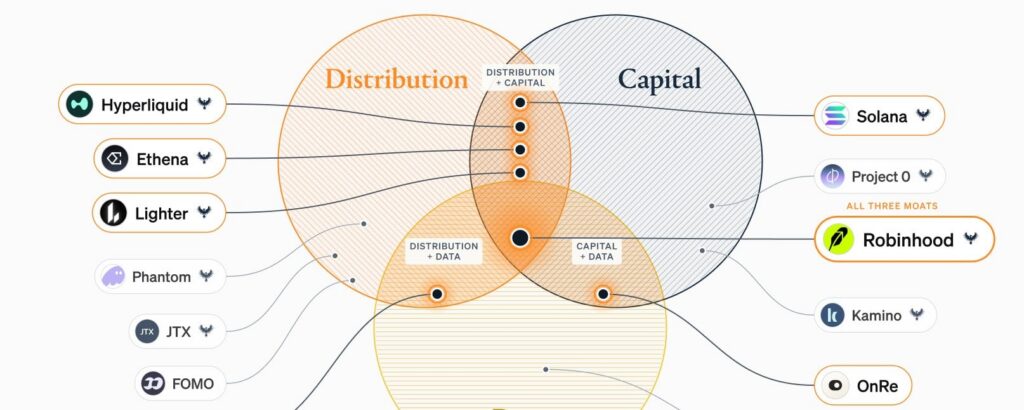
Those inputs are distribution, capital, and proprietary data. Risk tolerance is discussed separately, as a way into markets incumbents avoid, not as a durable moat. The essay presents this as the next iteration of earlier Multicoin work on work tokens and burn-and-mint equilibrium, then on unforkable state such as liquidity and network effects, then on value capture when a protocol must manage real risk.
Distribution: control of balances and order flow
Distribution is defined as the ability to decide where order flow or balances go. Stickiness is not uniform. A named, funded account that is hard to move is a barrier; a frontend alone is easier to contest.
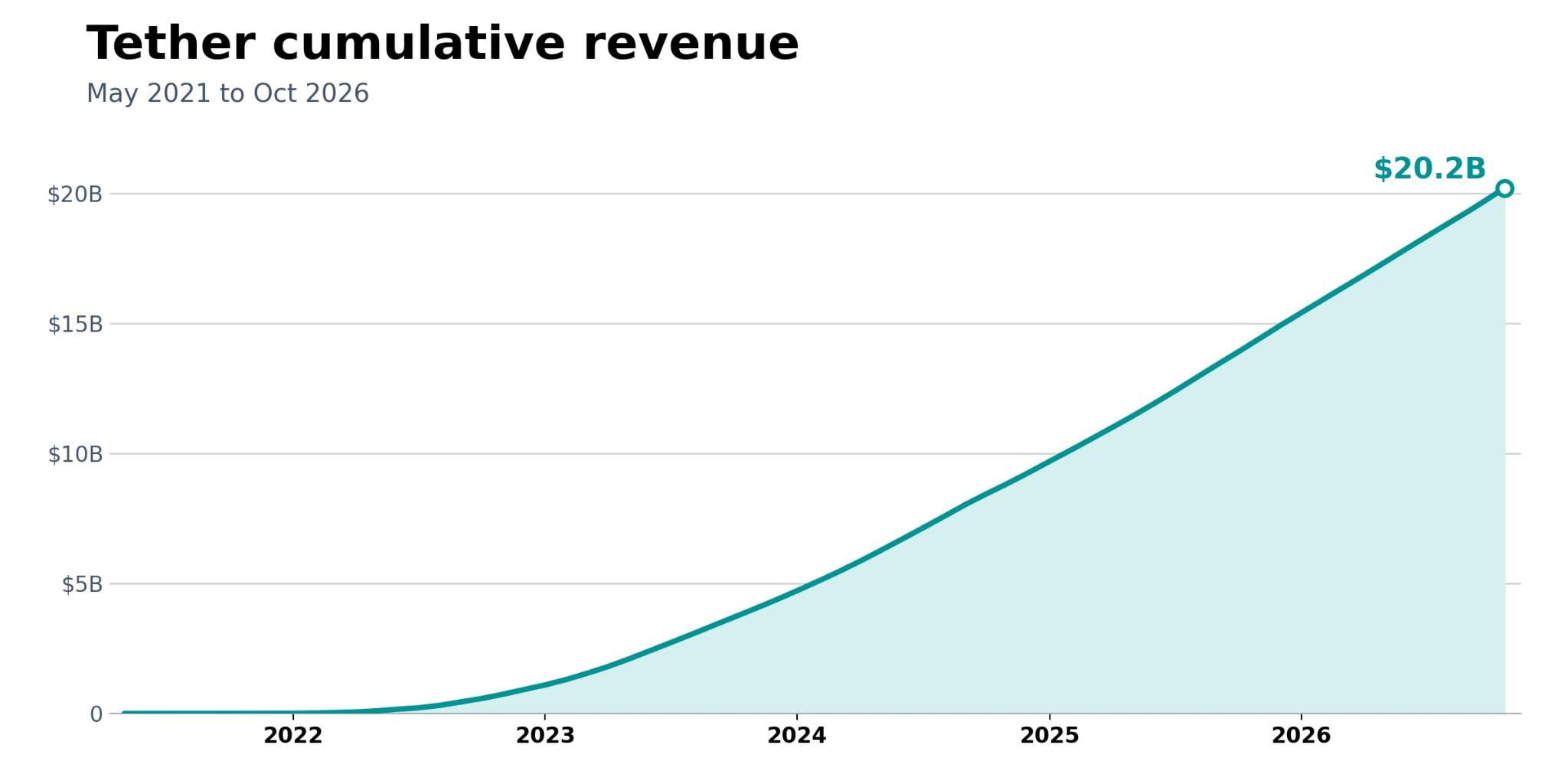
The stablecoin stack is the clearest pricing example. When scale is large and rates are not near zero, issuance has been a strong business. Tether and Circle hold dollar reserves and earn interest, and for most of the period they shared little of that interest with holders. Since 2021, Tether alone had earned more than $20 billion of near-100-percent-margin interest income. DefiLlama figures cited in the piece put cumulative revenue from May 2021 through October 2026 at $20.2 billion. That figure is issuer revenue from reserves, not trading activity and not a token-holder claim.
Hyperliquid is the counterexample on distribution. More than $6 billion of USDC sat on the platform as derivatives margin, and those balances generated reserve yield for Circle and its distribution partners. The essay’s reasoning is that Hyperliquid was why the balance existed, so it had bargaining power: if Circle would not share, Hyperliquid could substitute a stablecoin that would, or in principle issue its own. Earlier in 2026, under an aligned quote-asset framework, Hyperliquid and Coinbase agreed that about 90 percent of USDC reserve yield on the platform would go to the protocol’s Assistance Fund and be used to repurchase HYPE, rather than to Circle or Coinbase. On the $5.5 billion of USDC representing that 90 percent share, the arrangement was described as about $185 million a year. Hyperliquid did not have to run mint-and-redeem pipes, treasury management, or a license. The revenue here is reserve yield redirected by control of balances, and the stated token-holder path is buybacks through the Assistance Fund, not the margin balances themselves.
Wallets show the same split from the other direction. After early non-custodial wallets struggled to monetize, trading became the core product. MetaMask charges as much as 0.875 percent on swaps. Uniswap’s average fee over the prior 12 months was 0.13 percent, and most of that went to liquidity providers rather than to the Uniswap protocol. The venue must keep attracting liquidity providers, maintain infrastructure, and compete on slippage. The wallet mainly has to keep the customer and can send the order elsewhere if a quote is poor. With enough flow, a wallet or frontend can internalize more of the matching and keep a larger share of the economics. Phantom lets users trade Hyperliquid perpetuals and adds 5 basis points on top of Hyperliquid’s native 4.5 basis points. Hyperliquid runs the risk engine, matching, and liquidity; Phantom earns the higher cut from the interface and the user. The limit is already visible: in the Hyperliquid builder market, teams were cutting fees to retain users, so the frontend layer is not immune to commoditization either. Crypto wallets are also easier to leave than banks. Importing a key or seed phrase moves the same assets to a new interface in minutes. Changing a bank or fintech app means a new account, KYC, a transfer through traditional rails, a new payroll link, and updated connected services.
Robinhood is the large-account version of the same point: 28 million funded accounts. Uniswap was still the main DEX on Robinhood Chain, and Robinhood was described as content with that. Nothing in the cost of software stopped Robinhood from building its own DEX and directing flow there. The essay does not say Robinhood will do so. Holding the house book has not been Robinhood’s core aim, though the piece notes that Robinhood had begun routing a large share of prediction-market orders to its own venue, Rothera, rather than to Kalshi. The resulting picture is a waterfall. Frontends such as Phantom take a larger cut from venues; venues such as Hyperliquid take yield back from issuers such as Circle. How much profit remains at each layer depends on how hard it is for the user to leave. Hyperliquid was described as taking about 90 percent of the relevant reserve yield, while frontends running on top of it were already being pushed toward surcharges of only a few basis points.
Capital: funds that can take a loss
Headless protocols and backend infrastructure are not automatically the losers, because capital is a separate input. Traders need capital for leverage, market makers need it to quote, and lending protocols need deposits before they can lend. AI can write code and automate workflows. It cannot create the funds. When a system fails—the essay cites Aave’s KelpDAO episode and MakerDAO’s Black Thursday—someone has to cover the loss.
Liquidity does have logarithmic network effects: traders go where liquidity is, and liquidity follows traders. Open interest on Hyperliquid is an advantage, but that capital belongs to users who can leave. The piece recalls liquidity moving between protocols under token incentives and vampire attacks, then leaving when incentives fade. Two other forms of capital are treated as more defensive.
The first is a prime-brokerage function. Traditional prime brokers supply leverage and financing and let hedge funds use one pool of capital across markets instead of posting full margin at every venue. Industry prime-broker revenue rose from about $15 billion in 2020 to about $27 billion in 2024, helped by the growth of multi-strategy pod shops. The essay argues the DeFi version could be larger because smart contracts can automate work that makes small clients uneconomic for a traditional prime broker, covering a $500 retail ticket and a pod managing hundreds of millions. Traders currently post separate margin on Hyperliquid, Aave, Lighter, Morpho, Variational, and Kamino. A fund long tokenized equities in one place and short an equity-index perpetual in another should not, where the risks offset, have to fully collateralize both sides. The software for that netting is getting easier to build. The scarce parts are a balance sheet large enough to finance the positions, a low cost of funds, and risk experience that avoids a shortfall. Cheaper funding can attract more clients and then still-cheaper funding.
The second form is capital that backstops protocol risk, continuing an earlier Multicoin argument that protocol tokens which do not manage risk are easier to fork than tokens which do. Hyperliquid’s HLP vault supplies liquidity by making markets and taking over liquidated positions; depositors share profits and losses. In March 2025, HLP lost about $4 million handling a large ETH liquidation, and the later JELLYJELLY episode again pressured the book. Both episodes are cited as evidence for the role of a derivatives insurance fund. Aave’s Umbrella mechanism plays a related role, paying users extra yield to take bad-debt risk. The contracts can be forked. The dollars inside them cannot. Those dollars are still third-party funds and can leave if yields are higher elsewhere. Some stickiness comes from overlap between token holders and vault depositors: a HYPE holder might keep dollars in HLP to support the venue that supports the token exposure. The most stable version in the essay is retained earnings on the protocol’s own balance sheet, capital that does not exit for a higher short-term yield or a points program.
Binance is the owned-balance-sheet illustration. After a $6.3 billion theft on October 29, Binance filled the hole with SAFU reserves and company funds, mainly the latter, restored withdrawals within days, and saw a net asset outflow of only 3 percent. The piece treats trust in that balance sheet as what contained a run, while noting that the episode was still early. As DeFi extends into private credit, tokenized equities, and other real-world assets, demand for insurance capital and risk capital is expected to rise. Protocols that supply and run that capital are argued to capture more value than parties that only deliver software. User deposits, protocol revenue, and token-holder claims remain separate: a vault loss is borne by the capital that agreed to take it, not automatically by every token holder.
Proprietary data: underwriting what a block explorer cannot show
The third input is information, with a limit the essay states up front. DeFi was built on the idea that financial data should be public, which works for over-collateralized crypto lending and spot trading. As more real-world assets move onchain, models that depend on non-public information become more common. The moat is proprietary non-public data combined with the ability to price and underwrite from it.
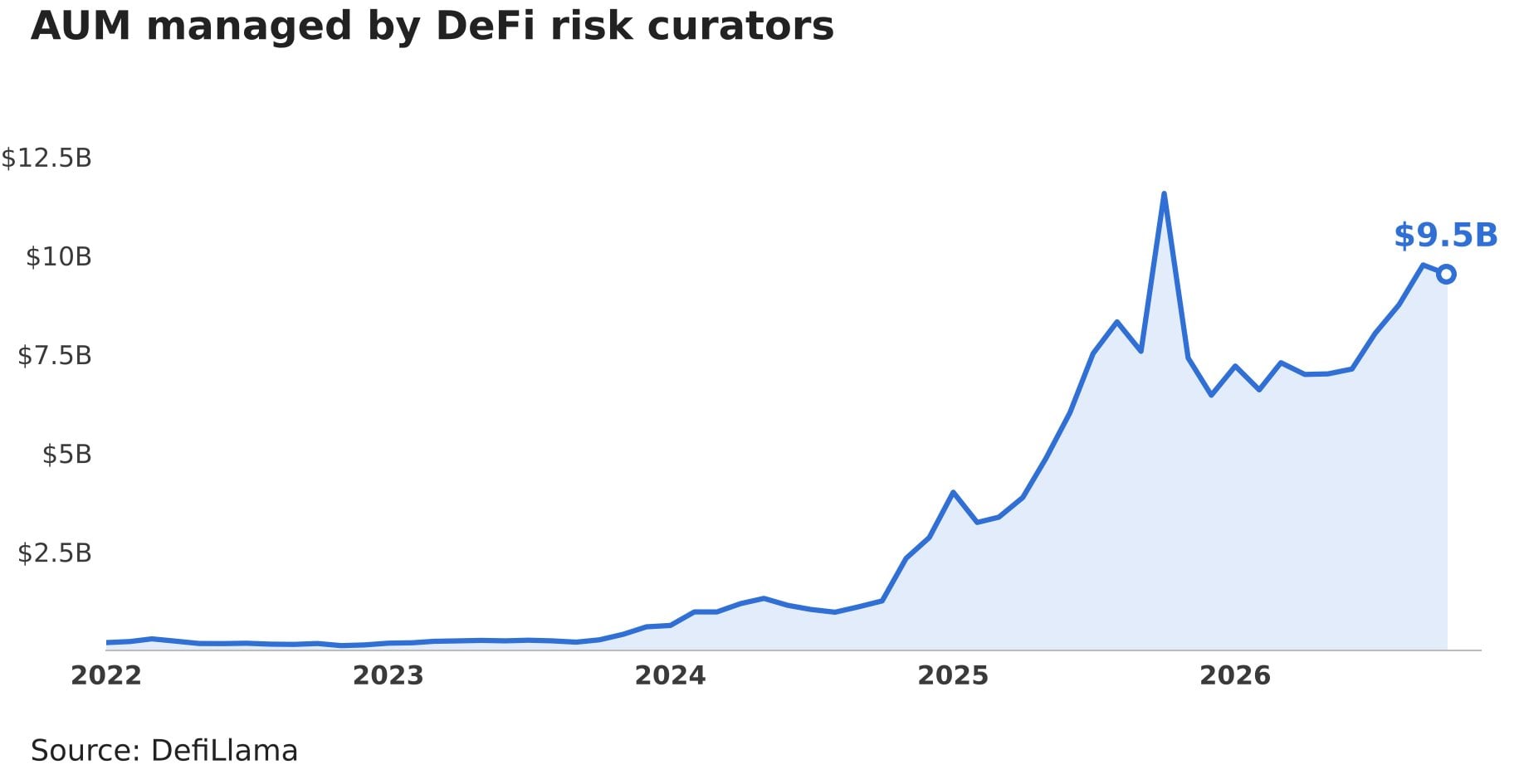
Lending shows the public-data case first. Risk curators on Morpho, Kamino, and Euler were managing $9.5 billion for depositors, according to DefiLlama figures in the piece. They have limited permissions inside vault contracts to choose markets, set risk parameters, and monitor collateral. Despite that assets-under-management figure, fee income was small relative to traditional managers with more discretion and more liability. Many curators charged almost nothing. Steakhouse Financial, the largest by assets, took a blended 22 basis points. The industry average was 19 basis points. Part of the reason given is that risk-adjusted DeFi yields were not especially attractive, possibly because large idle balances sit in Aave. Another part is that Morpho and Kamino commoditized the vault layer and sit between curator and depositor, which restates the distribution point. The deeper limit is that most curators use the same public data. For ETH or BTC collateral, price, liquidation rules, and the collateral itself are visible. AI makes the risk model easy to copy, so managers are pushed toward one-off judgment and track record, which the essay expects to pressure fees over time. Assets under management here are not revenue, and the thin take rate is not evidence that the assets are mispriced.
OnRe is the private-data contrast: an onchain reinsurer that raises capital from investors and underwrites real-world insurance risk. Pricing that risk requires historical claims, loss probabilities, and policy wording, plus actuaries who can read them. None of that is available in a block explorer. A model without the internal reinsurance book cannot produce the premium. OnRe charged 75 basis points plus 20 percent of excess return. At the returns then reported, that was about 3 percent annualized, roughly 16 times the average DeFi curator take rate. The businesses and the risks are different, and part of the premium compensates for illiquidity and the chance of principal loss. The claimed distinction remains: a firm with private data, underwriting skill, and a client relationship can charge far more than a firm that has only the same public data and tools as everyone else.
Chains, applications, and what the inputs do not prove
One colder reading in the essay is that generic L1 and L2 tokens are in a harder position, because chains used to confer distribution and capital on new applications and that bundle is weakening. Users historically kept assets on the most active chain, so building on Ethereum or Solana meant reaching those users. Starting Uniswap, Compound, Aave, Kamino, or MakerDAO inside an existing user base mattered. Cross-chain use is eroding that tie. A user can open an account in a mobile app and trade assets across chains without managing the underlying chain. More new users are expected to arrive through Revolut, Nubank, and Robinhood, firms that already have tens of millions of customers and do not require those customers to hold their own wallets.
Chains also used to supply capital through ecosystem wealth effects: a rise in SOL or ETH left users with more onchain money to deploy, and bridging friction plus community loyalty kept it there. Bridging is smoother, new money arrives as stablecoins, tokenized assets, and institutional flows, and issuers such as Securitize, Superstate, and Ondo tend to deploy on every major chain. On data, chains are described as having almost never had a moat, because most onchain financial information is public. AI also reduces one older chain advantage, the developer ecosystem of mature tools, audited code, and integrations, because applications can be moved across virtual machines more easily. General-purpose chains are left competing mainly on execution and settlement while blockspace is plentiful and fees per transaction keep falling.
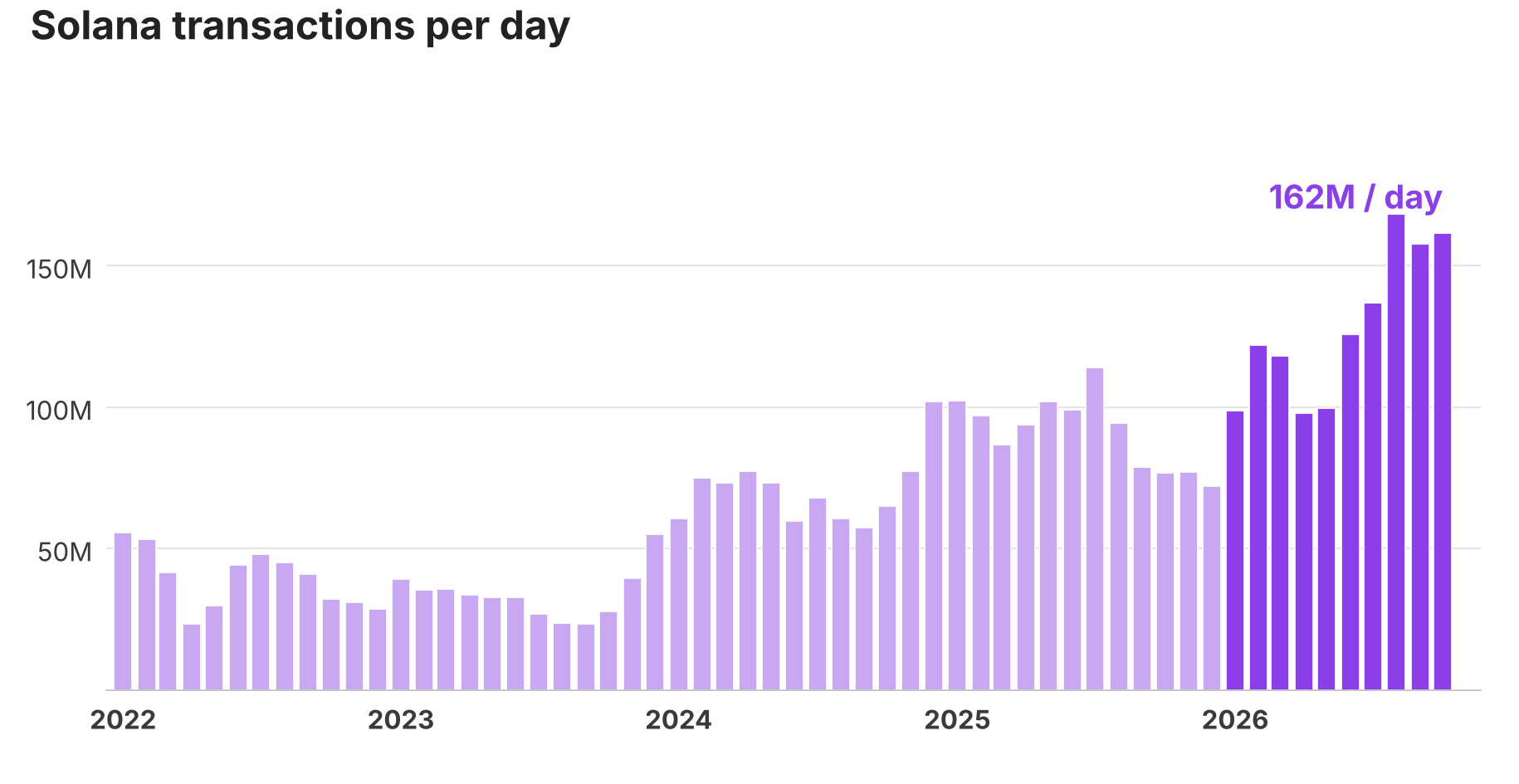
That is not a conclusion that a chain token cannot be valuable. The essay recalls an earlier argument from Tushar that an L1 token can function at once as a capital asset, a commodity, and a store of value. The illustration is arithmetic, not a forecast or a fair-value target: at one cent per transaction, one billion payments a day would be $3.65 billion of annual fees. Reported processing was still rising. Blockworks Research figures cited in the piece put Solana at 162 million transactions a day in 2026. Transaction count is activity. Fee revenue would depend on the price charged per transaction, which the essay says is still falling where blockspace is abundant. The stated implication is that the reason a chain is valuable may differ from the distribution-and-capital story investors first assumed. No multiple is offered as proof of overvaluation or undervaluation.
For applications and protocols, the essay’s test is whether the winner holds at least one of the three inputs: a direct customer relationship that is hard to move, as with Robinhood or Hyperliquid; a balance sheet that can absorb losses; or underwriting ability others cannot reach. Those three are argued to be harder to copy than software, regardless of how strong models become. Whether the claim sits in company equity or in a protocol token is treated as secondary; both can share the economics. Recent SEC guidance and draft rules had outlined paths for tokens to capture value in a compliant way, and Multicoin said it would keep allocating to those paths. The measure given is whether the entity controls a scarce input, has pricing power because of it, and can turn that advantage into investor returns. As more financial activity moves onchain, the gap in earnings and valuation between protocols with those inputs and protocols that are only software is expected to widen. That is an expectation about where pricing power sits, not a target price.
Risk tolerance is an entry wedge, not the moat
The objection the essay takes up is that incumbents already own the scarce inputs. Robinhood has the customers. Goldman Sachs has a larger balance sheet than any DeFi prime broker. Moody’s has the data and the license. If software is nearly free and moats are expensive, firms that already hold the moats should be favored.
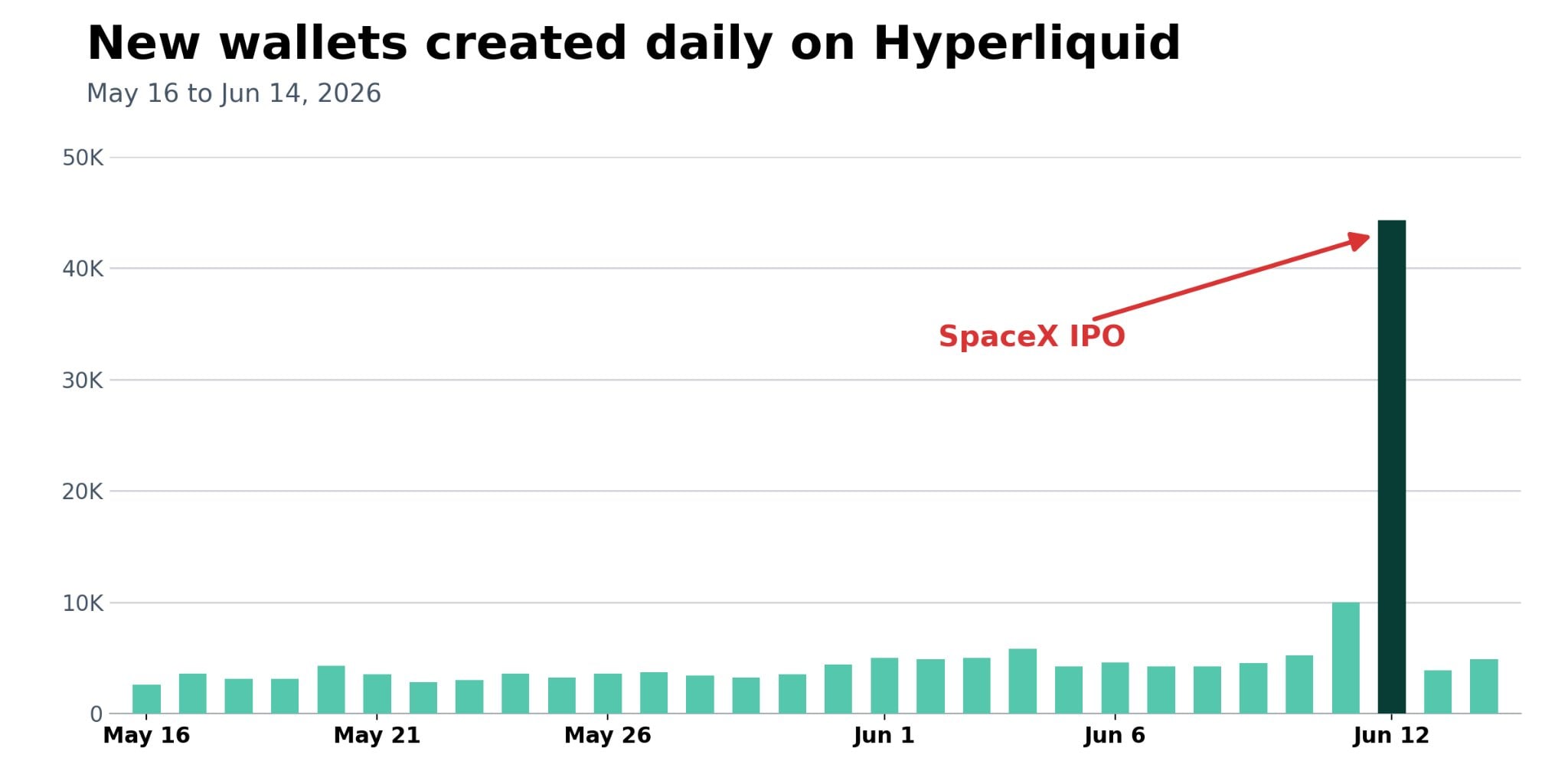
Startups are left with a different opening: risk that incumbents will not take. AI cuts both ways. It lets Robinhood assemble a DEX over a weekend, and it lets a three-person team move at a similar build speed. Ethena built a synthetic dollar around delta-neutral basis trades. The strategy is not obscure on Wall Street, but traditional firms, for compliance or internal limits, could not or would not run it on crypto venues. Ethena reached $5.4 billion of assets under management. Pump.fun and fomo started near zero, built a trading experience around memecoins as a new asset category, and captured large distribution; the essay calls them two of the cycle’s clearest winners. Hyperliquid entered a derivatives market dominated by Binance, Bybit, and OKX and took share. It also listed pre-listing perpetuals on private companies such as OpenAI and Anthropic, products licensed exchanges would not offer. That market drew new traders and liquidity. HyperTracker figures in the piece, covering May 16 to June 14, 2026, show new Hyperliquid wallets exceeding 40,000 on the day of the SpaceX IPO. On capital, Project 0 finances DeFi collateral that traditional prime brokers will not touch. On data, USD.ai underwrites and prices loans collateralized by GPU hardware, an asset the essay says traditional banks have little experience with.
The shared pattern is a segment left open because of regulatory constraints, operational complexity, reputation, or a market that initially looked too small. History in the piece suggests more of those openings will appear. AI lowers the cost of building the financial product. DeFi lets a small team reach global users and move capital without rebuilding the entire traditional stack. Risk tolerance itself is not a lasting moat. Regulation catches up, and once a market is proven, incumbents enter, as they did in spot bitcoin ETFs. A startup does not need a finished moat on the first day. It needs a market incumbents will not enter, and time to turn that position into distribution, capital, or proprietary data.
The close of the essay is that trillions of dollars of financial activity are expected to move onchain over the following decade, while AI pushes the cost of the software serving that activity to a level not seen before. Direct customer relationships, real risk capital, and non-public data do not become cheaper with the code. Code can be forked or generated by a model. The essay’s claim is that no model generates those three inputs, and that this is where it locates the opportunity for crypto investors. A disclosure in the original points readers to the Multicoin site; this account adds no further disclosure, data, or valuation conclusion.
Original article: TechFlow, November 11, 2026.