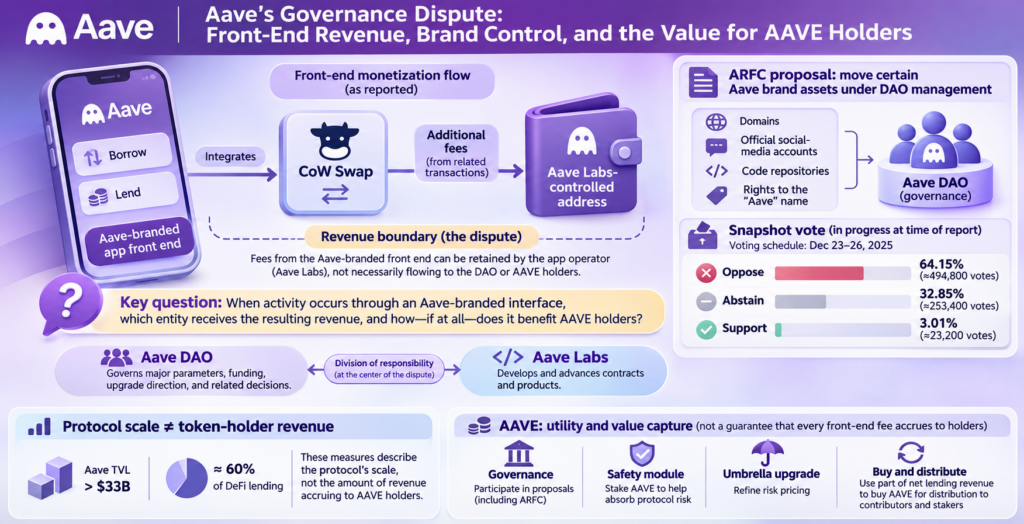
Aave’s December 2025 governance dispute raises a valuation question that lending volume alone cannot answer: when activity occurs through an Aave-branded interface, which entity receives the resulting revenue, and how—if at all—does that benefit AAVE holders?
The dispute followed Aave Labs’ integration of CoW Swap into an app front end. According to the original report, additional fees from related transactions flowed to an address controlled by Labs. Community members questioned the transparency of that arrangement and whether decisions about commercial revenue and Aave-branded assets had received appropriate DAO authorization.
What the proposal would change
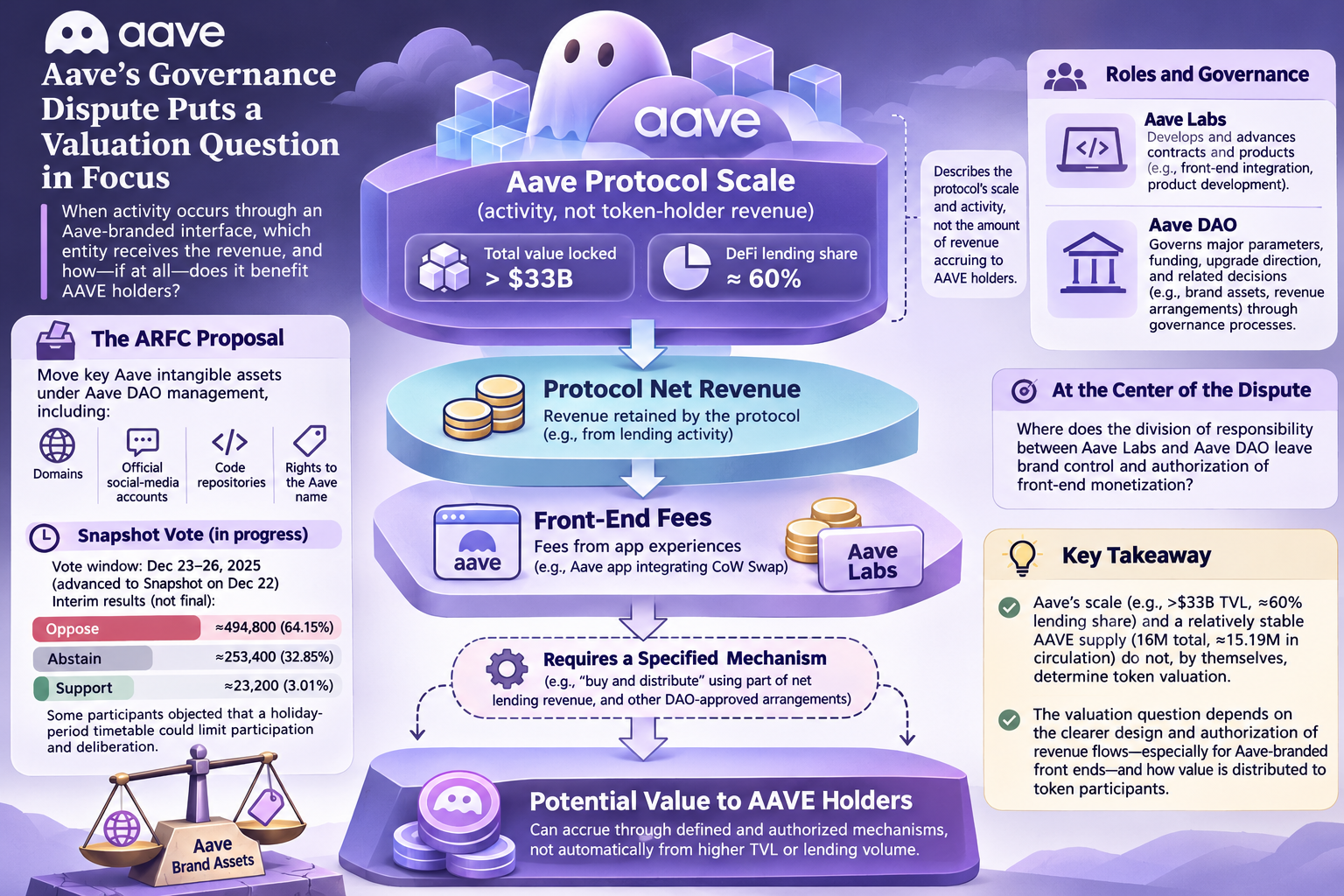
An ARFC proposal sought to place intangible assets—including domains, official social-media accounts, code repositories and rights to the Aave name—under Aave DAO management. The report identifies its proposer as a former Aave Labs chief technology officer and a BGD Labs co-founder. The proposal was advanced to a Snapshot vote on December 22, with voting scheduled for December 23–26, 2025. Some governance participants objected that the holiday-period timetable could limit participation and deliberation.
At the time of the report, the vote was still in progress: approximately 494,800 votes, or 64.15%, opposed the proposal; 253,400, or 32.85%, abstained; and 23,200, or 3.01%, supported it. These were interim figures, not a final result.
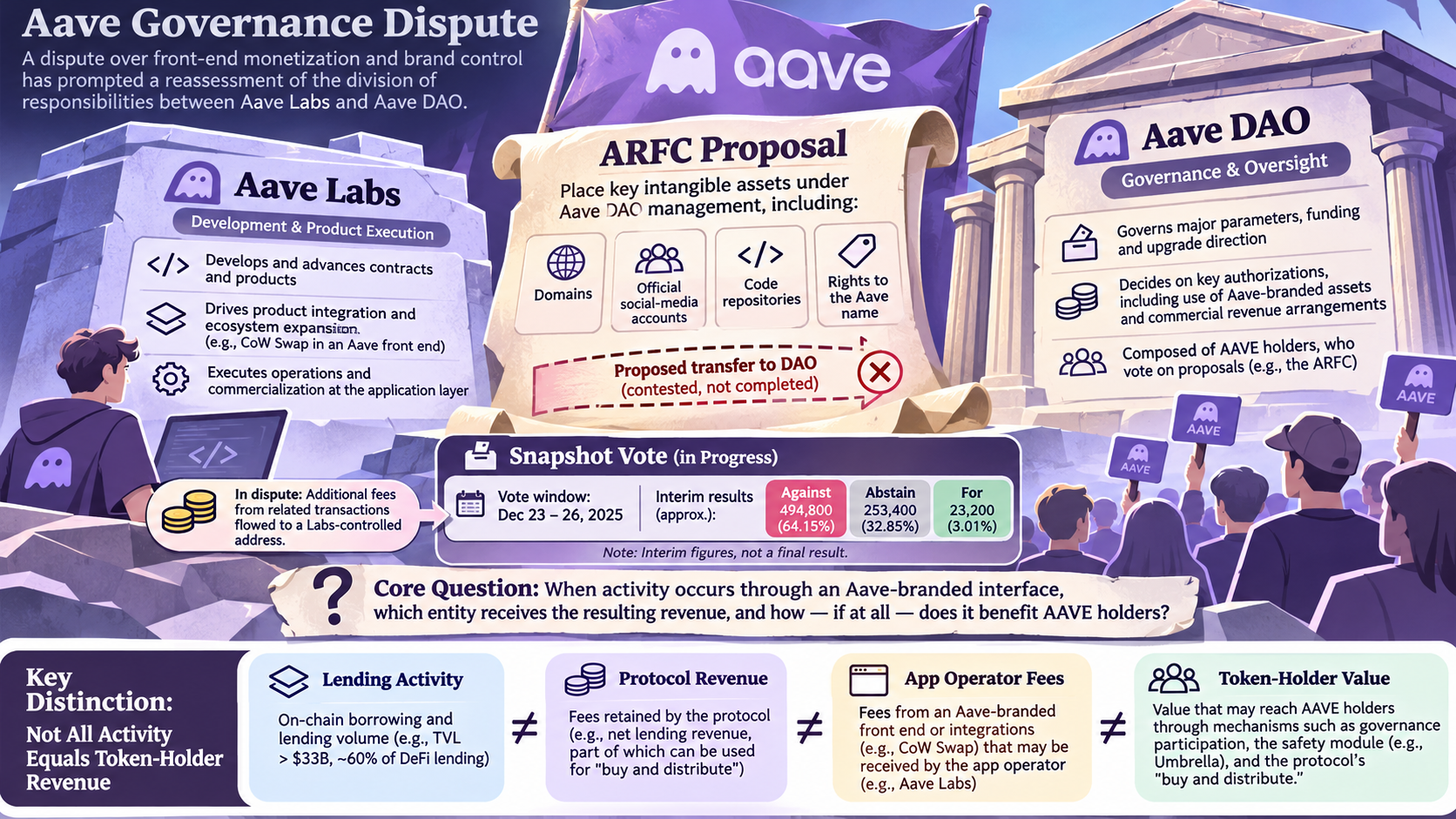
Protocol scale is not token-holder revenue
The report put Aave’s total value locked above $33 billion and its share of DeFi lending at roughly 60%. Those measures describe the protocol’s scale, not the amount of revenue accruing to AAVE holders. It also reported a 16 million AAVE total supply and approximately 15.19 million in circulation. A relatively stable supply does not, by itself, establish a token valuation.
The relevant distinctions are between lending activity, revenue retained by the protocol, fees earned by an app operator, and value distributed to token participants. The report described AAVE’s governance and safety-module roles, an Umbrella upgrade intended to refine risk pricing, and a “buy and distribute” approach using part of net lending revenue to purchase AAVE for distribution to contributors and stakers. None of those mechanisms means that every fee generated through an Aave-branded front end flows to the DAO or token holders.
Aave Labs develops and advances contracts and products, while Aave DAO governs major parameters, funding, upgrade direction and related decisions through governance processes. The ARFC dispute concerns where that division of responsibility leaves brand control and authorization of front-end monetization. A clearer boundary could make future revenue claims easier to assess; the interim vote alone did not resolve it.
Source: panewslab.com (originally published 2025-12-24 19:00 UTC+8)