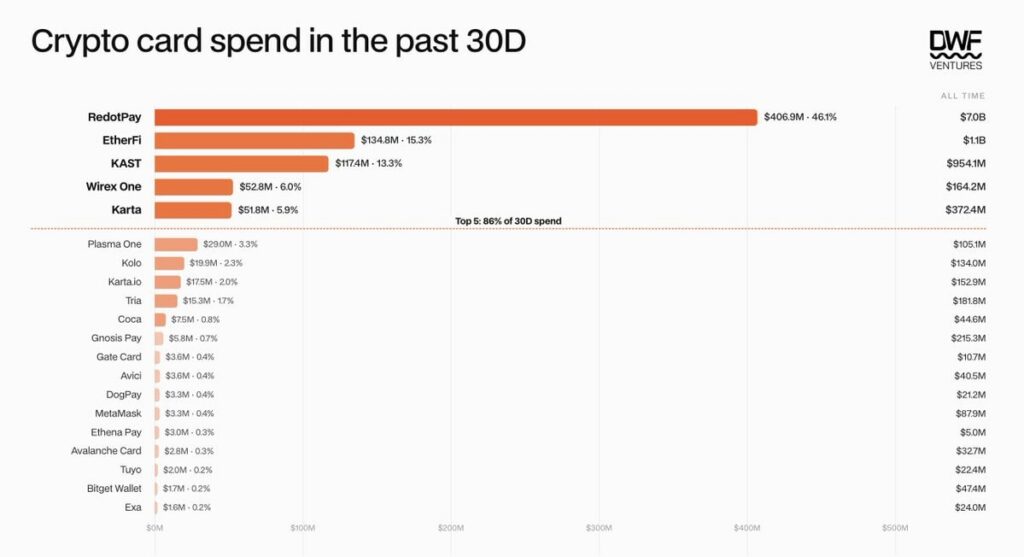
Weekly crypto card spending rose nearly 200% year over year, according to PaymentScan data cited in a DWF Ventures analysis published on November 25, 2026, at 09:56 (UTC+08:00). The five largest card programs accounted for more than 86% of spending, with RedotPay alone handling more than 46% of transaction volume. Those figures show how much customers spent and where. They do not show how much the card providers earned.
What a card provider keeps from a purchase
DWF identified three main sources of card-program revenue: fees on purchases, fees on foreign-exchange and crypto conversions, and fees for moving funds into or out of an account. Cashback returns part of that revenue to customers. DWF reported that after cashback, most programs retained less than 1% of the amount spent. Subsidies could cost as much as 2 to 3 cents per dollar spent. Reward caps limit that expense, but DWF said profitability remained uncertain.
For customers, the relevant comparison is cashback against the cost of using the card. Most card purchases settle in US dollars, and customers spending in another currency face foreign-exchange fees of 0.5% to 2%. That can offset almost the entire reward.
RedotPay illustrates a different approach. Rather than compete on rewards, it supports multiple payment methods and holds licenses in Hong Kong, the United States, Canada and Argentina. DWF argued that the availability of a cheaper alternative to traditional remittances in parts of Africa and Latin America helped RedotPay retain market share despite charging higher fees than rival card programs.
The economics of balances that customers do not spend
Customers spent an average of $0.65 to $0.75 for each dollar they loaded. Ether.fi and KAST, whose customers spent a smaller share of their deposits, offered annual percentage yields of 7% to 9% on dollar stablecoin deposits. DWF interpreted that pattern as evidence that customers valued the ability to earn a return alongside the ability to make purchases.
Issuing a stablecoin gives a card provider a way to earn interest on idle balances that would otherwise go to an issuer such as Circle or Tether. KAST issues its stablecoin through M0, while Ether.fi uses Ethena. At an assumed 4% yield, DWF estimated that balances held by Ether.fi users could generate about $2 million in annual revenue. That is a yield-based estimate, not reported earnings.
Other providers are expanding into lending and trading. Customers can borrow against assets held in an app through protocols such as Aave or Morpho rather than from the provider’s own balance sheet. Ether.fi Cash runs its credit service on Aave V4, and its loans exceeded $47 million. Phantom added perpetual futures trading to its wallet through Hyperliquid and, according to DWF, became one of Hyperliquid’s leading builders after launch. Alongside its card, the trading service lets customers spend, save and trade in one app.
Global settlement does not guarantee local access
Early mobile-first banks such as Revolut and Nubank attracted tens of millions of customers with cheaper cross-border payments and faster transfers, but still relied on traditional settlement systems and market-specific licenses. Stablecoin card providers can use infrastructure from companies such as Bridge and Rain to launch across dozens of markets. Yet shared issuing infrastructure also makes basic card features easier for competitors to match.
DWF distinguished three needs: a trusted place to save, a sustainable source of yield and a way to move money into local accounts. For savers seeking dollars where the local currency is weak, DWF argued that licenses, regulatory protections and a verifiable track record matter more than the ease of opening an account. On yield, it pointed to Ethena Pay: deposits earn returns from Ethena’s own strategies, while additional deposits increase demand for USDe and generate protocol revenue. DWF also considered dollar-denominated returns more appealing to a broad customer base than token rewards.
Local access remains the less widely available service. For someone earning across borders, receiving stablecoins solves only part of the problem; the recipient may still need local currency in an account they use to pay bills. DWF identified local payment connections and multicurrency settlement as stronger opportunities for differentiation than another cashback offer, precisely because those connections take time to build.