The US Justice Department filed a civil forfeiture complaint in the US District Court for the District of Columbia on November 23, 2026, Eastern time, seeking about $1.17 billion in USDC linked to the October 29 theft from Binance. At the time of publication on November 24, 2026, at 20:10:16 UTC+8, Circle had frozen the tokens, but the court had not ruled on forfeiture.
Why Circle would issue replacement USDC
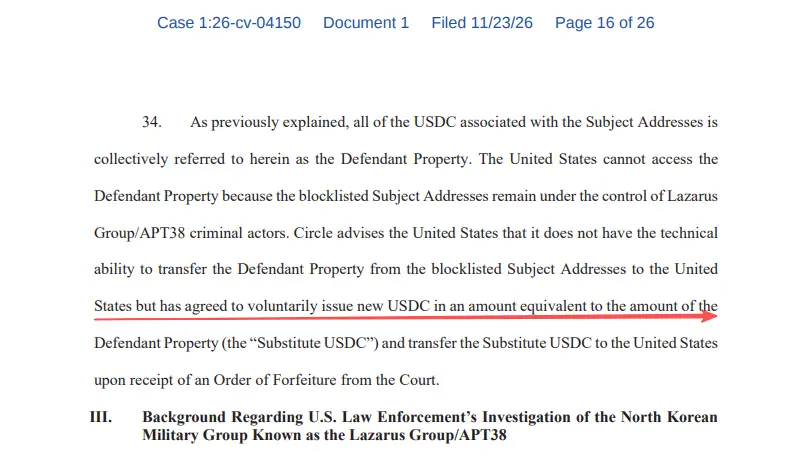
According to the complaint, Circle can block transfers from an address but cannot move USDC out of an address the attackers still control. Circle agreed that, if the court orders forfeiture, it will issue an equal amount of new USDC to the US government. The original tokens would remain frozen. The arrangement would therefore replace the frozen amount in circulation, not put both sets of tokens into circulation.
The Justice Department said the USDC was held at 36 addresses across 18 blockchains. Around October 29, Circle blocked four addresses that had directly received stolen funds. It later blocked another 32 compromised Binance addresses. Those successive freezes explain why the amount in the complaint exceeds the roughly $823 million in USDC that Circle CEO Jeremy Allaire initially said the company had frozen in coordination with law enforcement.
Prosecutors cited computer fraud, wire fraud and money laundering as grounds for forfeiture. They also asked the court to keep restrictions in place during the case because the expiration date of a November 12 temporary restraining order was unclear.
The Justice Department said it was helping Binance recover assets. While the government would receive the replacement USDC under Circle’s agreement, the complaint did not name an ultimate recipient or set out a distribution plan or timetable. Some analysts considered Binance the likely principal claimant because it had already covered customer losses; the court had made no such determination.
The theft and the scope of the freezes
Attackers drained Binance hot wallets across several blockchains in about 20 minutes on October 29. TRM Labs estimated the theft at $6.36 billion, roughly four times the size of the 2025 Bybit theft. Binance put the affected assets at about $6.34 billion and said it had replenished the full amount using its SAFU fund and company funds.
The complaint alleges that the attackers gained access to Binance’s internal systems through malware disguised as a job interview, then altered wallet authorizations to transfer assets. US investigators attributed the attack to North Korean military hackers. The FBI used the name TraderTraitor; the complaint used Lazarus Group and APT38. Prosecutors also attributed the roughly $1.5 billion Bybit theft to the group and said some wallets that received stolen Binance funds had previously received funds from the September Bitget theft, which caused about $387 million in losses.
On the night of the Binance theft, Tether CEO Paolo Ardoino said the company had frozen more than 1.567 billion USDT. On November 12, the Justice Department said it had obtained court authorization to seize or restrain more than $1.2 billion in stolen assets and that the US government and private entities had together frozen more than $2.7 billion. On November 18, Binance said the Abu Dhabi Global Market Courts had issued a $6.5 billion worldwide freezing order requiring 18 entities, including Circle and World Liberty Financial, to keep relevant tokens frozen. The order’s face value was not a measure of funds recovered.
Bitcoin and ether remain harder to recover
On November 23, the Justice Department said US authorities had helped freeze, seize or return more than $2.9 billion in crypto assets since the theft. That combined figure was still less than half the estimated loss, and not all of it represented assets returned.
Elliptic tracked about $2.22 billion remaining at related addresses, mainly in ETH and BTC. Since November 1, the attackers had sent at least 3,930 BTC, worth about $247 million, into CoinJoin transactions. They had obtained that bitcoin by exchanging other stolen assets. By contrast, the 18,270 BTC taken directly from Binance had been split among 19 addresses on the night of the theft and had not moved since.
Unlike USDC, bitcoin and ether have no issuer that can freeze balances. Investigators could track those assets, but the freeze-and-reissue arrangement available to Circle was not an option for recovering them.