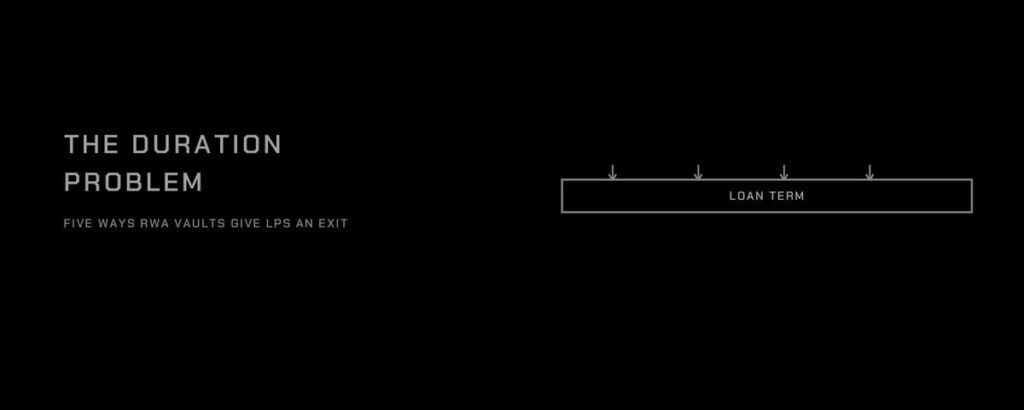
A stablecoin depositor can leave a credit vault before its borrowers repay, but only if the vault has cash or someone else buys the depositor’s claim. In an analysis published on 27 November 2026 at 20:54:26 UTC+8, nikos compared five ways real-world asset (RWA) protocols fund early exits. Each gives a different answer to two questions: how much cash can a depositor receive now, and who bears the risk that the borrower ultimately pays back less than expected?
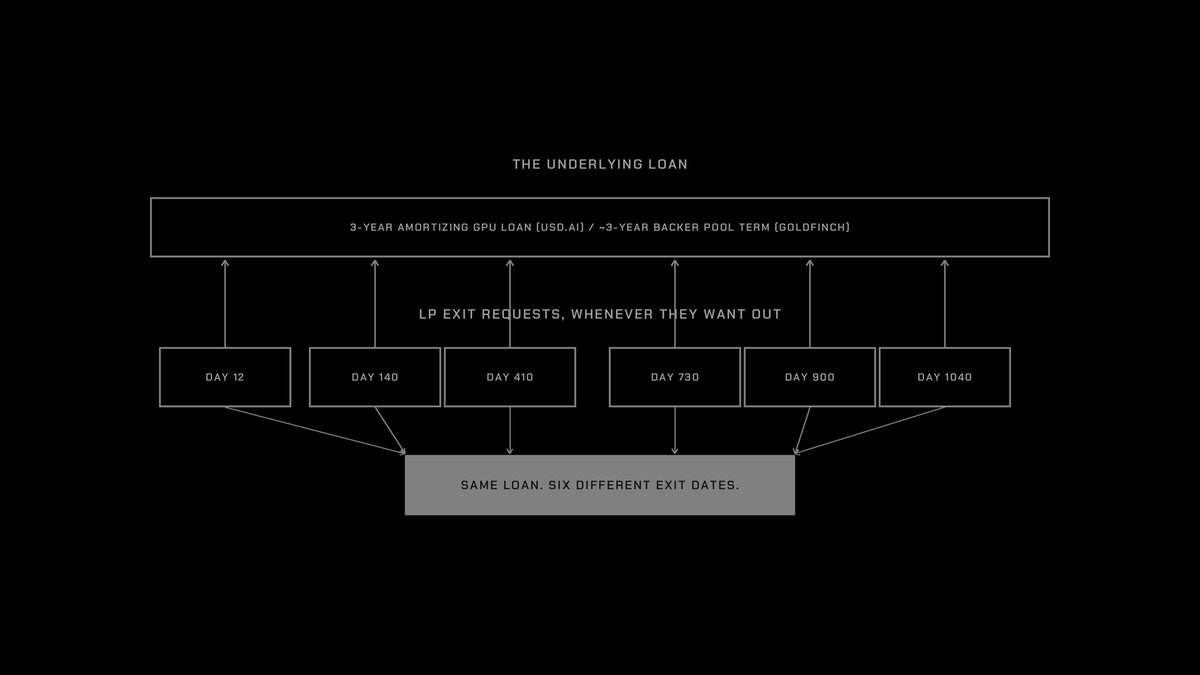
USD.AI’s GPU-backed loans illustrate the timing problem. Borrowers repay principal and interest every 30 days over three years. Loans in Goldfinch’s Backer Pools have also historically averaged three-year terms. That schedule can suit a business financing equipment or borrowing against receivables. It need not suit a depositor who needs stablecoins before the next payment arrives.
1. Cash buffers: the queue determines who gets paid
USD.AI caps new lending at 90% of total sUSDai capital, leaving at least 10% outside the loan book. It processes redemption requests in 30-day cycles on a first-in, first-out basis. A large request near the front can absorb all the cash available in a cycle, leaving nothing for later requests.
Goldfinch’s Senior Pool uses a different rule. It processes withdrawals every two weeks and, when available USDC falls short, distributes it in proportion to the amounts requested. Each applicant receives a partial payment rather than waiting for earlier applicants to be paid in full.
Centrifuge’s earlier Tinlake pools used processing periods of at least 24 hours and gave redemptions priority over new loans. That priority governs how the pool uses its cash; it does not guarantee that the cash will cover every request. Once a buffer runs out, further withdrawals depend on repayments or new inflows.
2. Tranches: priority is not a source of cash
A senior tranche has the first claim on repayments. Junior investors absorb losses first and typically receive a higher yield in exchange. In Goldfinch’s original design, FIDU holders had exposure to multiple Backer Pools and could redeem when the Senior Pool had unloaned capital. Junior investors in an individual pool remained committed until its loans were repaid or written off. In Tinlake, senior DROP tokens likewise had redemption priority over junior TIN tokens.
Seniority therefore matters both to the order of payment and to the allocation of losses. Even the most senior investor, however, needs cash in the pool to redeem.
3. Secondary markets: the exit price depends on trade size
Maple Finance depositors can sell syrupUSDC or syrupUSDT on a decentralized exchange such as Uniswap instead of joining Maple’s first-in, first-out withdrawal queue. The Goldfinch community also maintained a FIDU/USDC pool on Curve, without the protocol itself supplying market-making liquidity.
The seller exchanges a wait for a market price, after fees and slippage. A large sale may clear well below the token’s net asset value (NAV). A hypothetical vault with $100 million in total value locked could still have little secondary-market depth. For a depositor, the useful measure is how much of the position can be sold at a given discount, not how much capital the vault holds overall.
4. Transferable claims: selling an existing place in line
Centrifuge’s proposed ERC-8161 standard would extend the ERC-7540 asynchronous vault model by making pending deposit and redemption requests transferable. A depositor could sell a pending redemption claim at a discount. The buyer would acquire the existing request and its queue position, rather than buying the vault token and joining the back of the queue.
For a vault with a redemption window measured in weeks or months, that distinction could matter to both parties. The seller could receive cash sooner if a buyer were willing to pay, while the vault would keep its settlement schedule. The proposal would transfer the remaining wait, not shorten it.
5. Requests for quotes: a vault buys the wait at a discount
Symbiotic’s Liquid Lane uses on-chain requests for quotes (RFQs) to connect sellers with curated liquidity vaults. In KPK’s USDC RWA liquidity vault, the curator sets a minimum purchase discount and a spending cap for each eligible asset; smart contracts enforce those limits. KPK’s published discounts were 0.05% for Centrifuge’s JTRSY and JAAA and 0.80% to 3.00% for certain Midas and Pareto assets.
A purchase must meet two further tests: its expected return must exceed the yield available from deploying the capital on Morpho, and at least 50% of vault capital must remain immediately available afterward. The purchased asset then goes to a designated redemption account, and the vault holds the claim until the issuer settles it.
Some Centrifuge assets can settle immediately with no cooldown. Certain Midas assets typically take 12 to 36 hours, while some wrapped Pareto assets can take 32 to 63 days. The purchase discount compensates the vault for waiting and bearing credit risk; it is not a guaranteed gain. If the discount is inadequate or the issuer redeems below expected NAV, the liquidity vault’s depositors bear the loss. No external insurance fund covers it.
When the question changes from timing to recovery
Goldfinch originated about $100 million in loans, some of which later became seriously delinquent. Goldfinch reported recovery periods exceeding two years. Estimated write-downs for some pools ranged from 80% to 100%; those estimates were not confirmed losses across the entire loan book.
When a performing borrower pays slowly, the question is who can fund the wait. When a borrower cannot repay, the question is how much principal remains to distribute. A quoted yield or withdrawal window answers neither question. Assessing an exit requires knowing how much cash is available, which requests have priority if several large depositors seek payment together, and what price an outside buyer will actually pay.