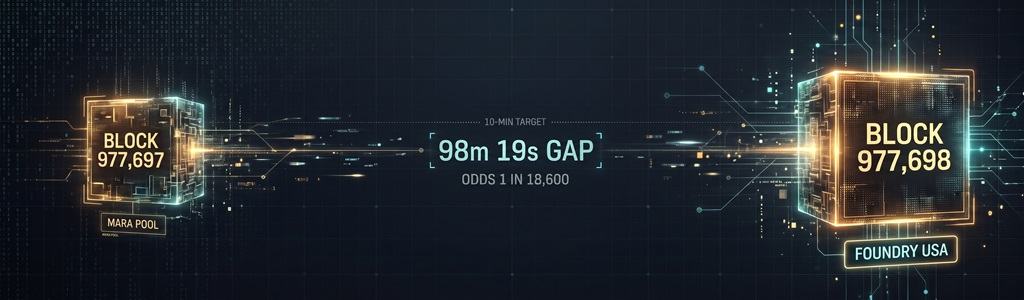
Bitcoin miners took 98 minutes and 19 seconds to find the next block on November 26, 2026. According to mempool.space records cited in a November 28, 2026 report published at 05:10:05 UTC+8, MARA Pool mined block 977,697 at 16:49:54 UTC on November 26. Foundry USA mined block 977,698 at 18:28:13 UTC that same day.
The odds apply to a single interval
Alex Thorn, head of research at Galaxy, estimated the probability of waiting at least 98 minutes at approximately 1 in 18,600 for any one block interval. His calculation assumes an exponential distribution with a 10-minute mean. Ten minutes is an average, not a deadline: Thorn’s charts covering the preceding 24 months showed that 63.2% of blocks were found within 10 minutes.
Each attempt to find a valid hash is independent. As Thorn explained, a mining rig that has worked for an hour is no more likely to succeed in the next second than one that has just started. The technical analysis he cited attributed the delay to random variation, not a network failure. Bitcoin adjusts mining difficulty every 2,016 blocks to keep the average interval near 10 minutes; a long wait does not trigger an immediate adjustment.
Thorn described the gap as the third of its duration in 2026, the longest since July and the 69th-longest since 2011. In his initial post on X, he gave the block heights as 977,967 and 977,968 before correcting them to 977,697 and 977,698. An earlier example documented by ForkLog was a 100-minute gap between blocks 688,436 and 688,437 during China’s 2021 mining crackdown.
Fees and subsidy in block 977,698
Transactions accumulated during the wait. Foundry USA’s block contained 3,723 transactions, compared with 3,445 in the preceding block. It was about 1.44 megabytes in size and weighed 3.99 million weight units, just below the consensus limit of 4 million. Its hash was 00000000000000000001c2758d4dcd15bb5b4fceb3ecbfa18bdcdb085f2fd327.
The median fee rate was about 12 satoshis per virtual byte. Total fees came to approximately 0.156 BTC, nearly twice the preceding block’s fee total. Most of Foundry USA’s 3.281 BTC in block revenue nevertheless came from the 3.125 BTC subsidy, not transaction fees.
Mining conditions in 2026
Mining conditions had fluctuated during the year, but the technical reports did not directly link those changes to the November 26 wait. Winter Storm Fern contributed to an 11.16% difficulty reduction on February 7, followed by a 14.7% rebound 12 days later. In March, difficulty fell 7.76% while network hashrate stood near 942.83 exahashes per second.
By September, hashrate had remained below its record high for 316 consecutive days, while several operators had redirected energy capacity toward artificial intelligence infrastructure. On November 10, Binance permanently closed its Bitcoin mining pool and associated cloud mining services.