Coinbase nearly doubled its share of global crypto trading to 10.7% over the year to November 2026, yet its third-quarter net transaction revenue fell 44% year over year. The mix of trades helps explain the divergence: volume in its high-fee US retail spot business fell nearly 60%, while Coinbase was competing for customers with lower-fee products.
On November 25, 2026, Coinbase shares traded below $102 intraday, more than 60% below their 2026 high of $263 and about 77% below their all-time high of $444.60. Bitcoin was trading below $60,000 after seven consecutive weekly declines.
Coinbase reported $719 million in third-quarter net income. Unrealized gains on crypto assets held for investment totaled $715 million, equivalent to 99.5% of that profit. Adjusted net income, a separate measure, fell 82% to $77.7 million, and the company recorded a net loss for the first nine months of 2026. Fourth-quarter transaction revenue was about $165 million through October 25. For the full quarter, Coinbase expected adjusted expenses to exceed $1 billion, up from $975 million in the third quarter.
What $2 billion in buybacks bought
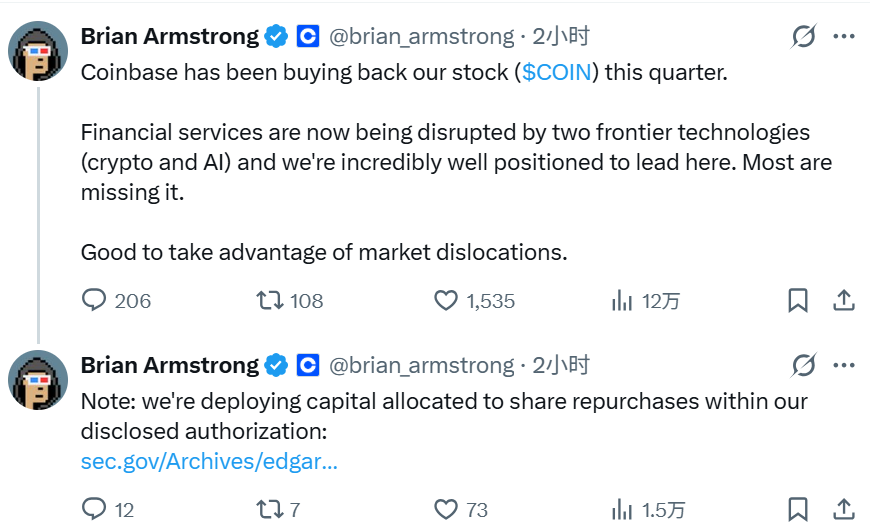
CEO Brian Armstrong said on X on November 25 that Coinbase had continued buying back shares during the fourth quarter under its existing authorization. He argued that crypto and AI were reshaping financial services and that the market price presented an opportunity to deploy capital.
SEC filings showed that Coinbase bought about 38,000 shares in the third quarter at an average of $139.91, spending approximately $5.316 million. That purchase price was well above the November 25 trading level. Cumulative repurchases totaled about 10.17 million shares at a cost of roughly $2 billion.
The buybacks offset more than 85% of shares issued since the fourth quarter of 2024, but they did not eliminate dilution from equity compensation. Shares outstanding rose from 263 million in the first quarter of 2026 to 265 million in the third. Executives separately sold shares under 10b5-1 trading plans.
More trading products, lower fees
After integrating INTX and Deribit in October, Coinbase opened Bitcoin and Ether options backed by Deribit liquidity to eligible non-US customers on November 19. US institutions could access the options through Coinbase Prime, while US retail customers still had to wait. The company had warned that the migration could cause short-term fluctuations in trading volume.
Coinbase Advanced also introduced spot margin trading with up to 10 times leverage on major assets and about five times on others. Customers could use more than ten types of collateral and share margin across spot and derivatives positions. US individuals faced a $10 million discretionary investment threshold to qualify as eligible contract participants, as well as state and use restrictions.
Coinbase planned to relaunch Coinbase Pro by the end of 2026, bringing spot, futures, perpetuals, options and equities into one account. The fee trade-off matters: lower-priced derivatives and professional trading, alongside zero-fee spot trading through Coinbase One, can help Coinbase compete with offshore and decentralized exchanges. But a dollar of volume on those products does not generate the same fees as a dollar of high-fee retail spot volume.
Prediction markets: the cost of sharing fees
Coinbase’s prediction-market business had surpassed $200 million in annualized net revenue, a run rate rather than a full year of realized revenue. Activity remained sensitive to the sports calendar and, during quieter periods, to demand for contracts tied to crypto volatility. Coinbase relied mainly on Kalshi for contracts. Revenue sharing with external exchanges as the business grew helped push third-quarter transaction expenses to 16.8% of net revenue.
Bloomberg reported that Coinbase planned to launch its own prediction market for US retail and institutional customers in the first half of 2027. Coinbase acquired The Clearing Company in 2025 and secured registration for Coinbase Clearing in September 2026. Its proposed design would clear trades internally and hold customer margin on-platform in USDC, potentially allowing Coinbase to earn both trading fees and Treasury interest associated with USDC balances. Neither the launch nor those earnings were assured. Disputes over state and federal oversight, including litigation involving Kalshi, remained risks.
Base: collateral use is distinct from revenue
As of November 25, DefiLlama put total value locked on Base at $4.95 billion. Base’s own figures showed more than $1 billion in cumulative tokenized-stock trading volume since launch. Coca-Cola and Walmart were among the US equities added in November.
With Robinhood already offering commission-free US stock trades, the distinction on Base was what holders could do with tokenized shares after buying them. Holders had deposited a substantial share in protocols such as Aave as collateral, allowing those assets to support borrowing even when US stock markets were closed. The Base App could also connect those assets to perpetuals, prediction markets, payments and automated settlement for AI agents.
Neither value locked nor trading volume measures revenue accruing to Coinbase. Nor was a Base token a settled part of the plan: Base lead Jesse Pollak said on November 22 that the team was exploring issuance but did not want it to distract from platform growth. Armstrong said he would devote more attention to customers and products and pointed to 2027 as a key period for delivery. For shareholders, the open question was how much income Coinbase could retain from those products as high-fee spot trading declined.