On November 10, 2026, Odaily reported that Anthropic had introduced two new Claude models on the same day a circulating IPO pricing note was being disowned. The valuation question is which figure is in view. A token price, a rumored primary raise, a private-round post-money mark, a market expectation for the whole company, and a synthetic on-chain quote are different measures. None of them, in the material assembled that day, was an official Nasdaq print for Class A shares.
What the model release changed
Citing Anthropic’s blog, Odaily reported that Claude Fable 5.2 and Claude Mythos 5.2 share one underlying model and are aimed at the hardest technical tasks, with claimed gains in coding, reasoning, and vision. Fable was available to all paid users on Claude and on Amazon Web Services, Google Cloud, and Microsoft Azure. Mythos required an application through a life-sciences or cybersecurity verification program.
Two commercial terms are numerical. Odaily said Claude account replies and the API pricing page agreed: standard API rates of $8 per million input tokens and $40 per million output tokens, down from $10 and $50 — a 20% cut on each. Optional fast mode was $16 and $80 per million input and output tokens, with token generation described as up to about 2.5 times faster. Output speed was described as up to about 30% faster than version 5.1.
Odaily also relayed pre-release testing claims: three production-ready electronic devices designed from scratch, two open black-hole physics problems solved, and a formal proof of Fermat’s Last Theorem finished within 30 hours. Wharton professor Ethan Mollick was quoted saying the new model had nearly reached AGI. Odaily added that unnamed AI evaluation sites ranked the latest Claude model first. The report does not name those sites or give scores, so that ranking stays an attribution, not a reproduced benchmark.
A lower token price and a faster generation rate describe what a customer pays and how quickly tokens are produced. They do not measure Anthropic revenue, margin, or any accrual to Class A holders.
The filing on record, and the note that did not stick
Odaily reported Anthropic’s October 26, 2026 announcement: an S-1 filed with the U.S. Securities and Exchange Commission to list Class A common stock on the Nasdaq Global Select Market under the ticker ANT, with Goldman Sachs and Morgan Stanley as leads. Share count and price range were not set. CNBC’s live coverage that day listed 22 firms in the syndicate.
By November 10, Odaily wrote, the public filing had met the SEC’s minimum of 15 calendar days, and the week had entered a window for direct investor meetings. The Wall Street Journal, citing people familiar with the matter, reported that Anthropic still planned to advance the IPO in November 2026, targeting an open of trading on Nasdaq on November 19 or 20.
The same account separated three expectation ranges, none of them a cleared offering range:
- Earlier market estimates had been near $2 trillion.
- After a selloff in AI stocks, more recent expectations were about $1.5 trillion.
- A further reduction to $1.2–1.3 trillion was described as not ruled out.
Reuters, based on an email to investment banks, reported a sketch of about 867 million shares at $70 to $80, raising up to about $69.3 billion. Later word was that those pricing details were inaccurate and would be updated. An Anthropic spokesperson declined to comment. The $69.3 billion figure is a reported maximum amount raised under that sketch — shares in the deal times price — not a stated value for the whole company, and Anthropic had not confirmed it.
The last priced round is not the IPO
Odaily cited Anthropic’s announcement of a Series H that closed on May 28, 2026: $65 billion raised at a $965 billion post-money valuation, led by Altimeter Capital, Dragoneer, Greenoaks, and Sequoia Capital. Of that $65 billion, $15 billion was prior commitments from cloud providers, including $5 billion from Amazon. Those commitments are not the same as cash already received.
The report said Anthropic’s prospectus still showed heavy spending in the model race, and treated that cash need as one reason for pushing a public offer. That is an inference from the filing as described, not a reproduced use-of-proceeds table.
On-chain marks are a separate market
After the pricing-note confusion, Odaily recorded sharp moves in pre-IPO perpetual markets. The levels below are the quotes in that November 10, 2026 report, not later settlements.
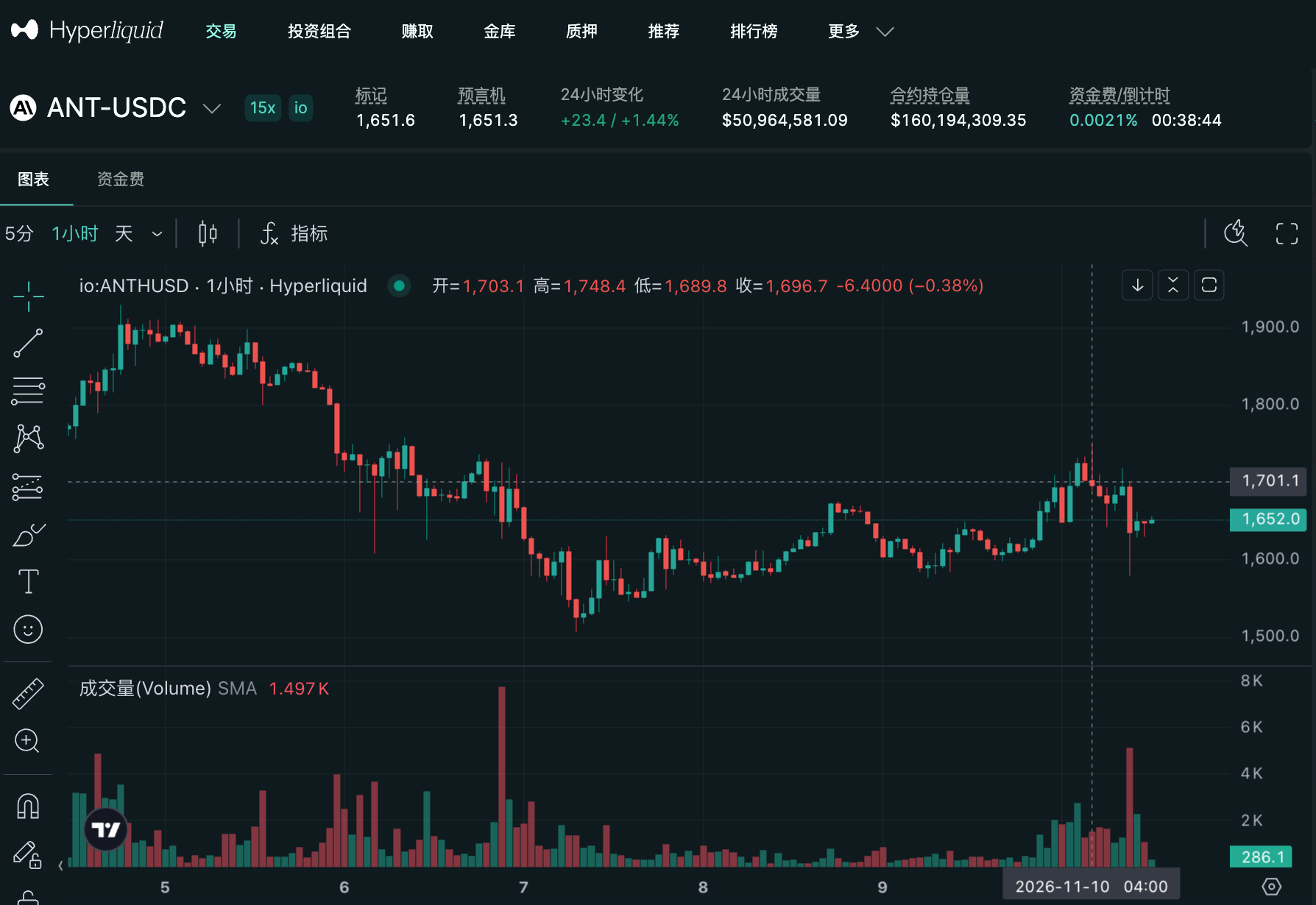
Hyperliquid ANT (IO). The mark briefly reached about $1,748 and was then quoted at $1,651. Under that market’s own pricing method — the formula was not published — Odaily said the quote implied an Anthropic valuation of about $1.64 trillion. Versus a November 4 close of $1,865.4, the decline was about 12%. Reported 24-hour volume was about $50.96 million, with open interest of about $160 million notional.
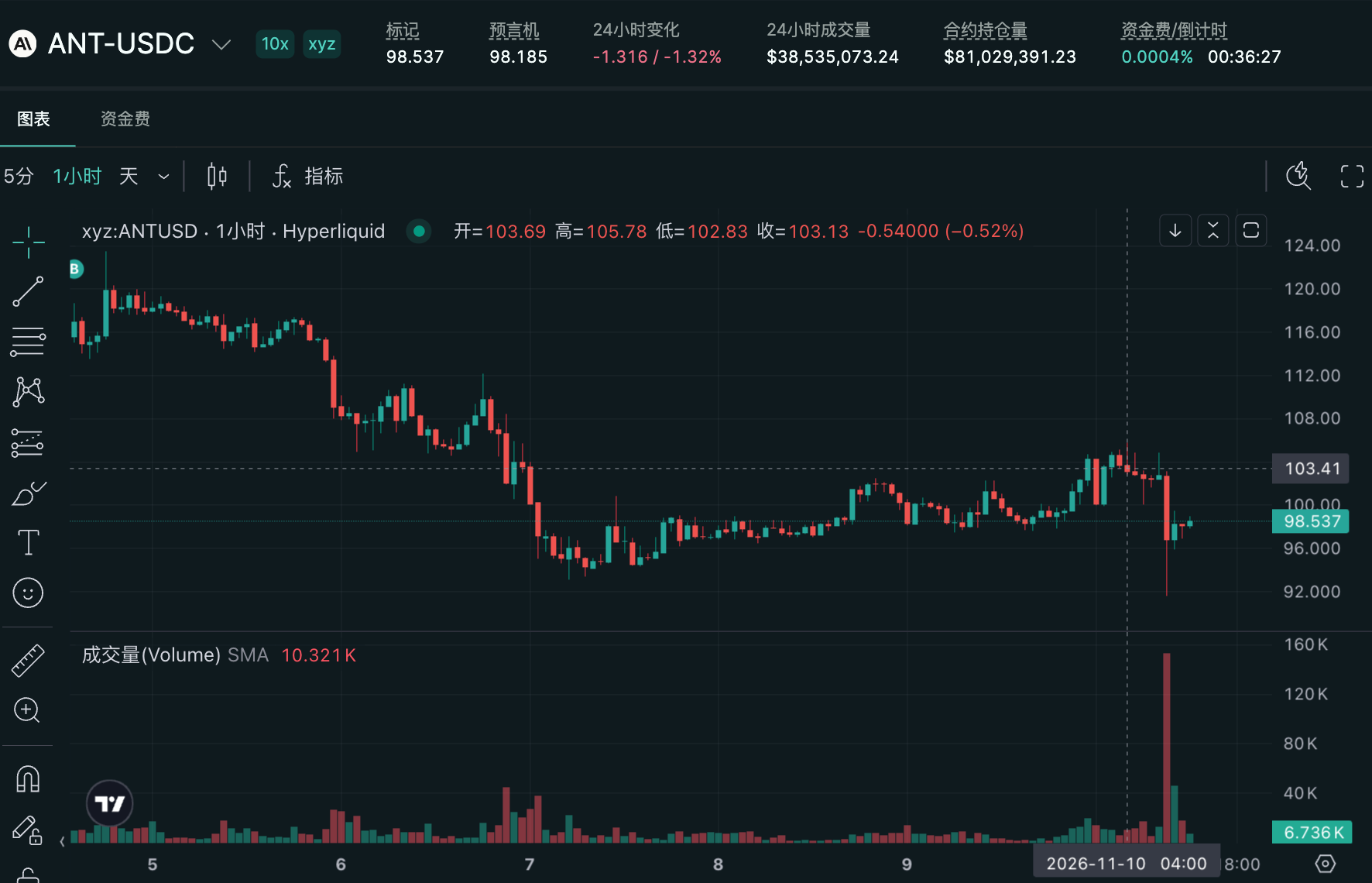
ANT (XYZ), as an expected per-share quote. It briefly hit $105 and was later quoted at $98.5, down about 1.32% over 24 hours, on about $38.53 million of volume and about $81 million of open interest. This is not the same unit as the IO mark. Reading $98.5 and $1,651 as two prints of one share price mixes conventions.
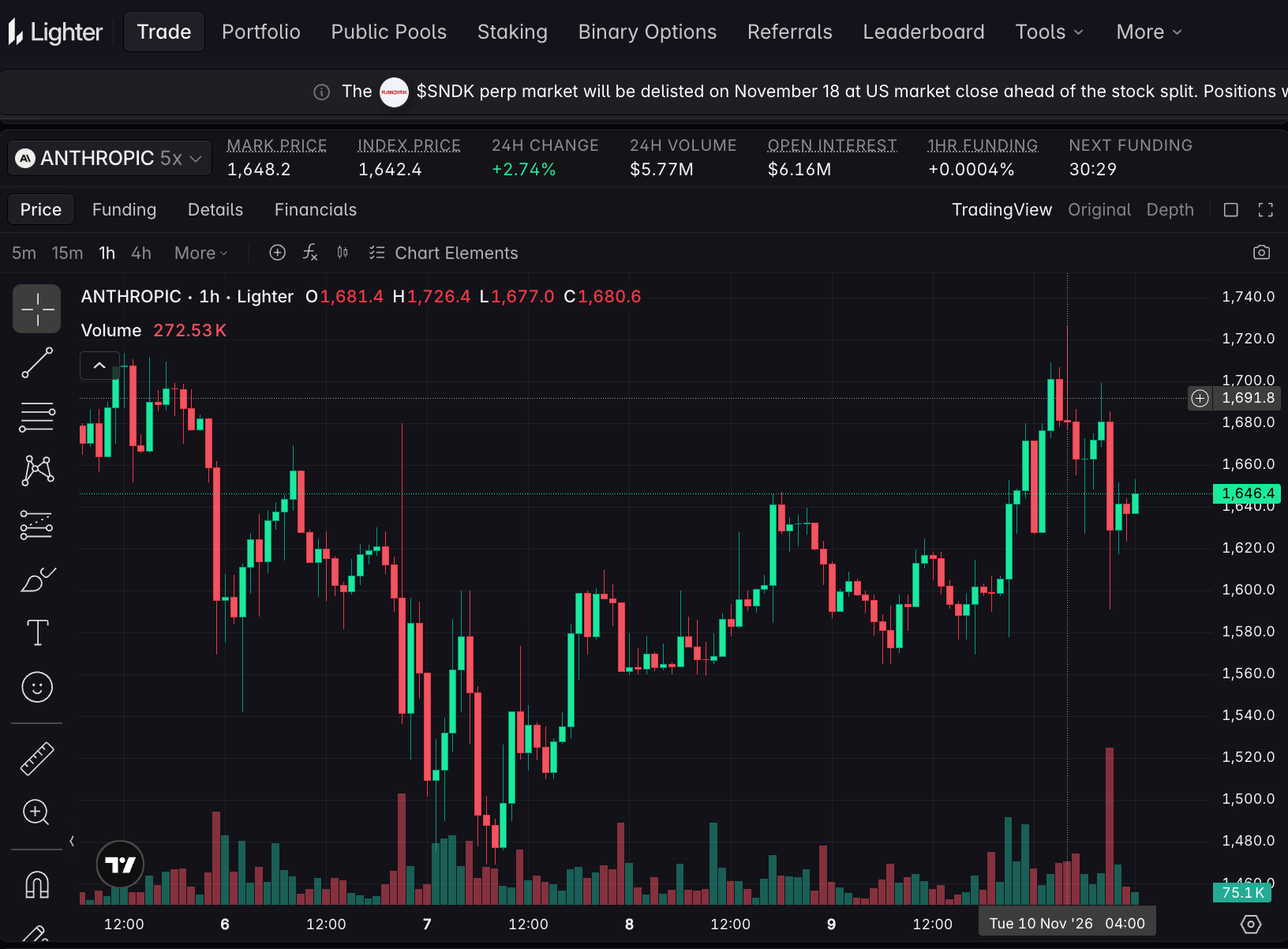
Lighter ANTHROPIC. The pre-IPO price briefly hit $1,726 and was later quoted around $1,648, about $3 from the Hyperliquid IO mark. Volume was about $5.77 million and open interest about $6.16 million. Odaily described that book as much thinner than the other two.
The article’s summary was that pre-IPO pricing was still disputed, while the valuation range implied by these marks stayed above $1.5 trillion, pending an official pricing document. That summary does not erase the separate expectation, via the Journal, that the IPO might be discussed near $1.5 trillion or as low as $1.2–1.3 trillion. Both were reported. Neither is a fair-value estimate.
What these inputs do not decide
The reference points actually supplied can sit side by side: a May 28, 2026 post-money mark of $965 billion; talk near $2 trillion that had already faded; an expectation band of about $1.2–1.5 trillion; an on-chain IO implication near $1.64 trillion; and a withdrawn sketch of up to about $69.3 billion raised at $70–$80 a share. The spread is the observation. No multiple in the report turns model rank, token prices, or one perpetual print into proof of overvaluation or undervaluation.
Two limits follow from the sourcing. IO, XYZ, and Lighter quotes are exchange marks for synthetic exposure, not Class A shares in an S-1 and not a claim on Anthropic revenue. And several of the sharpest product claims — the Fermat proof, the physics results, the device designs, and a first-place model ranking — rest on company testing notes or unnamed evaluation sites as relayed that day, not on a published dataset with its own measurement date beyond the November 10, 2026 report.
Official price and share count remained unset. The next hard number, on Odaily’s account, was the updated pricing document that had not yet been issued.
Original report by Wenser (@wenser 2010) for Odaily (@OdailyChina), published November 10, 2026, at 12:51 (UTC+8): https://www.odaily.news/post/5213844